The New Rules of Brand Selection
Five Questions CPG Leaders Need to Answer About AI and the Future of Commerce
Executive Summary:
The next shift in commerce will change how brands compete for shoppers’ purchases. As consumers delegate purchasing decisions to AI assistants, strong consumer preference can settle brand choice before an assistant enters, while brands left unspecified must earn their place in consideration. This gives mental and physical availability new strategic significance, raises the stakes for genuine differentiation, and could reshape the balance of power across commerce ecosystems.
This Growth Paper explores five questions to help CPG leaders understand what is changing and how to get ahead:
We close with a practical decision-influence assessment to help you identify where brand growth is exposed, evaluate competitive position, and prioritize where to invest to build advantage in the next era of commerce.
Why is this next shift in commerce different, and why does it matter for brands?
For most of the last century, the rules of CPG growth have been rewritten each time a new player came between the brand and the shopper.
Exhibit 1: Each commerce shift has moved influence closer to the moment of choice
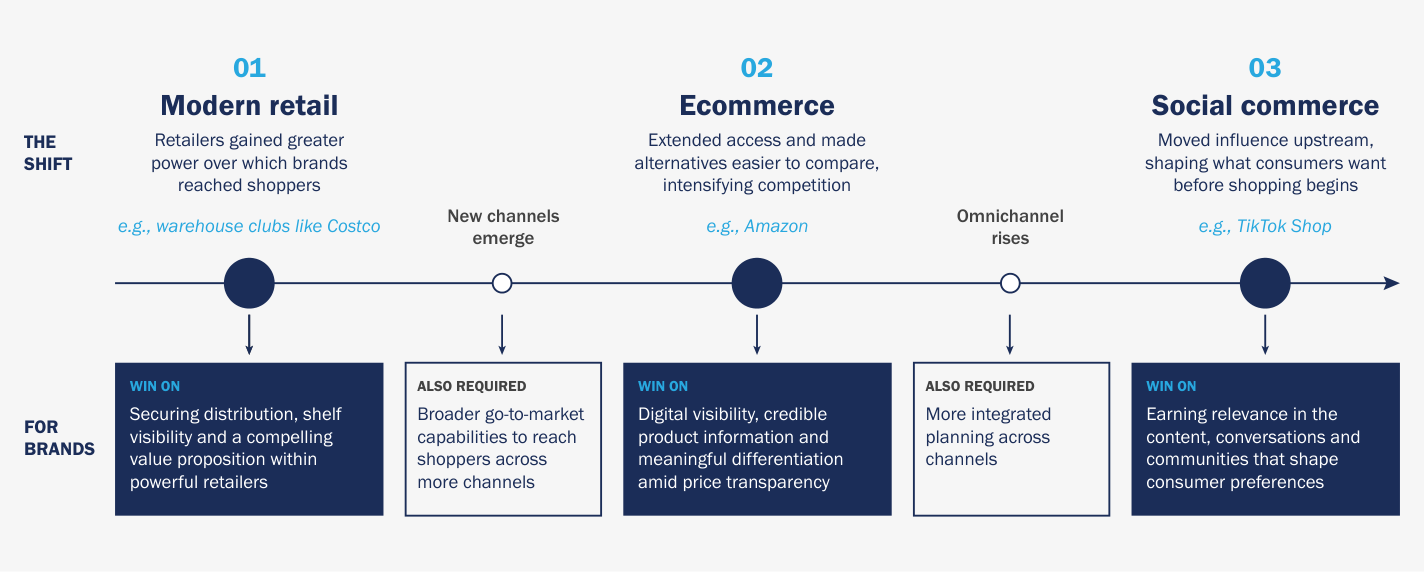
The power pendulum has swung from brand owner, to retailer, to digital platform.1 Each shift created new threats and sources of advantage, changing what brands needed to do to compete for growth.
Agentic AI introduces a different kind of change. Earlier shifts changed where shoppers bought and who influenced them.2 Now, AI assistants could take on parts of the purchasing decision itself. Depending on their needs and preferences, consumers may retain control over certain decisions while delegating others to an intermediary. For brands, this creates a new competitive reality: the same purchase could play out very differently depending on which decisions the shopper has already made and which remain open to influence. The result is a redistribution of decision-making power, in which brands must compete not only for access to shoppers but for influence over the decision itself.
Shopping is becoming unbundled – which shopping decisions will consumers retain, and which will they delegate?
Shoppers have always varied in how much thought they give a purchase. What’s new is that they can now separate the work of shopping from the choice itself. A consumer can delegate search while retaining final choice, specify a brand while handing over execution, or define a need and allow an AI assistant to determine which product best satisfies it.3
This makes the path to purchase more fluid. A brand may generate consumer interest only to be excluded when an AI assistant narrows the options; another may enter consideration through an AI recommendation despite never having appeared on the shopper’s radar. The traditional funnel remains useful for understanding conversion, but it offers a less complete picture of competition when different actors can form, narrow, or reopen consideration, potentially without the shopper directly evaluating every alternative.4
Exhibit 2: Gaining and maintaining consideration is fluid
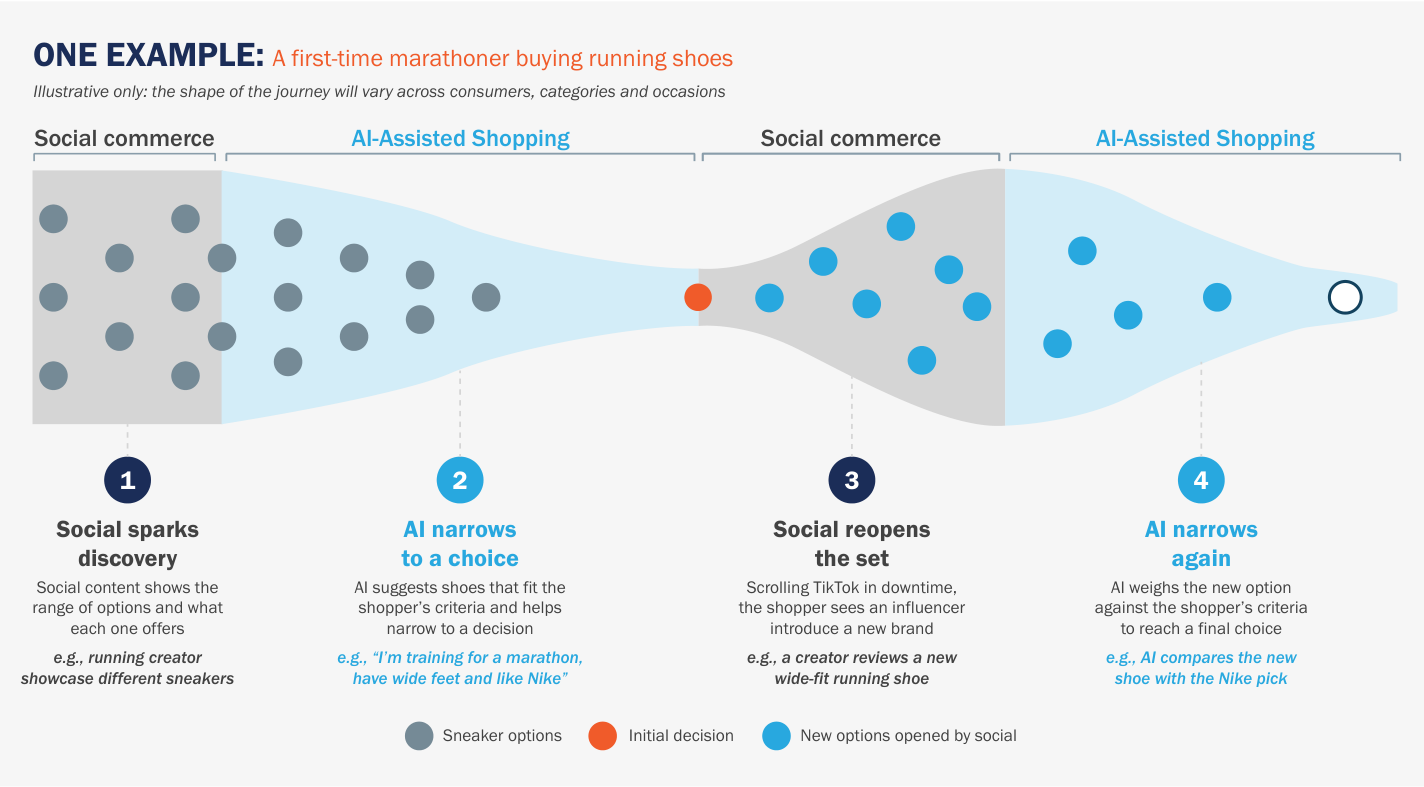
Not every purchase is equally open to competition. What shoppers specify in their requests determines how much discretion the assistant has. When a shopper asks an assistant to “buy Tide,” brand selection is already settled, even if retailer, pack size, and delivery remain open. A request to “find detergent for sensitive skin” leaves brand selection unresolved, allowing the assistant to influence which products enter consideration, even if the shopper retains final choice.
How can brands build preference and win when choice remains open?
In AI-assisted shopping, one of the strongest positions a brand can hold is being the name in the request. Strong consumer preference can effectively settle brand choice before the assistant gets involved, while brands that aren’t specified must earn their place in consideration. Brand strength can therefore determine whether brand selection is open to competition, as well as the likelihood of winning when it is.
This gives two enduring fundamentals of brand growth, mental and physical availability, new strategic significance. Mental availability becomes a powerful means of shaping what shoppers ask for, increasing the likelihood that they specify a brand before delegating the purchase.
When brand selection remains open, brands face two hurdles: their products must be available through the retailers and commerce systems AI assistants use, and their advantages must be recognizable through accessible product information and credible, substantiated claims.
But being easy for a machine to read is not the same as being worth choosing. A strong AEO strategy can amplify a great product, but it can also make a mediocre one easier to reject. Without genuine differentiation, optimizing for machine evaluation risks shifting competition toward readily comparable attributes, price, availability, and standardized claims, driving a race to the bottom.
The more selection is automated, the more advantage shifts back to understanding how to delight consumers. Lasting differentiation depends on uncovering the unmet needs, evolving motivations, and cultural shifts that shape what consumers value. Brands must translate these insights into distinctive propositions consumers genuinely value, backed by the evidence and availability AI assistants need to recognize and recommend them.
Who stands to gain influence as the commerce ecosystems evolve?
As more purchasing decisions become open to influence, commerce players have growing incentives to expand their roles and shape more of what consumers ultimately buy.



Together, these developments point to a growing competition among commerce players for influence over the decisions that determine what consumers buy.
What does this mean for how brands build demand and invest for growth?
Brands that create distinctive consumer value and architect category innovation will continue to carve out mental availability while also elevating their strategic partnership value, which increasingly depends on the decisions it influences alongside the transactions it delivers. Brands that generate consumer demand have greater leverage in these relationships, while those with less differentiated propositions risk relying on intermediaries to generate consideration and determine selection.
Customer strategy is therefore becoming inseparable from demand strategy. Choosing where to invest and which ecosystems to prioritize requires understanding:



This creates two imperatives: build consumer preference strong enough to put the brand in the shopping request, and ensure the differentiation, evidence, and availability needed to win when selection remains open.
Where to Start
A decision-influence assessment can help brands identify where growth is at risk, how competitive dynamics may shift, and where to invest to build advantage. Four steps provide a starting point:

Examine shopping journeys across priority segments and identify which decisions shoppers make themselves, which they may delegate to AI assistants, and how this changes where preferences form, what drives selection, and where brands are exposed.

Develop scenarios for how retailers, platforms, creators, and AI assistants could gain or lose influence over shopper requirements, consideration, and selection. Assess how these shifts could change your brand’s routes to growth.

Identify where shoppers seek your brand and where you must compete to enter consideration. Assess whether your differentiation, claims and availability within ecosystems are strong enough to win when brand selection remains open.

Determine your competitive strengths and gaps, then prioritize investments in brand building, innovation, shopper marketing, commerce capabilities, and ecosystem relationships based on their potential to create and capture future growth.
The brands that take advantage of the new rules for getting chosen won’t optimize for a single path to purchase. They’ll understand how decisions unfold across shoppers and intermediaries, how influence is shifting across commerce ecosystems, and build the advantage to win whether choices are made by shoppers or by intermediaries acting on their behalf.
The next era of commerce is changing how brands get chosen. Let’s identify where your brand can win.
We’re happy to talk: info@seuratgroup.com
Sources
- Buying Power of Multiproduct Retailers: Key Findings, Summary and Note
- Social Commerce
- Buy It in ChatGPT: Instant Checkout and the Agentic Commerce Protocol
- The Consumer Decision Journey
- Inside Walmart’s Strategy for Building an Agentic Future
- Walmart Completes Acquisition of VIZIO
- How Social Commerce Is Reshaping Ecommerce and Retail in 2026
- Buy It in ChatGPT: Instant Checkout and the Agentic Commerce Protocol