
The Future Belongs to Brands That See It First
Why today’s forecast misses tomorrow’s shifts & how foresight reveals the blind spots in your strategy
In 2007, BlackBerry controlled nearly half of the U.S. mobile market. When the iPhone launched that same year, BlackBerry dismissed it as a fragile gadget with no keyboard and weak security. Android joined the race in 2008, but BlackBerry didn’t release a competitive touchscreen device until 2013. By then, BlackBerry’s market share had collapsed to under 4% in the U.S.
BlackBerry wasn’t bad at making phones. It failed because it ignored the early signals of a fundamental market transformation:
Shifting identity and culture: Mobile devices were evolving from corporate work tools into expressive extensions of personal identity, status, and lifestyle.
Emerging interface innovation: Consumers were quick to embrace more intuitive, touch-first interactions over keyboard messaging.
New business models: Value expanded from selling standalone hardware to connected ecosystems pairing devices with content, apps, and other digital services.
Focused on executing day-to-day operations, BlackBerry failed to anticipate what was coming next. By the time leadership finally looked up, the market had already moved on. Most strategic plans make the same mistake. They extrapolate past successes and tweak at the margins. That approach holds up only when the future resembles the past, and it breaks the moment the landscape changes. Today, these shifts arrive faster than ever. Look at the CPG industry: challenger brands are seizing category share and redefining growth.
This is the gap that foresight is built to close.
From Insight to Foresight
Insight explains what people want, feel, and need today, giving businesses a clear picture of the present. Forecasting takes historical data and projects it forward—reliable when conditions are slow, stable, and predictable, but brittle when they’re not. Insights and forecasts often exist in a vacuum, because consumer needs don’t change in isolation. They are shaped by external forces like technological shifts, economic pressures, and cultural swings. While insights explain why something is happening right now, and forecasts project forward what has happened in the past, foresight connects the dots between signals of change to anticipate shifts that will impact future habits, mindsets, and expectations. Think of it like driving a car:
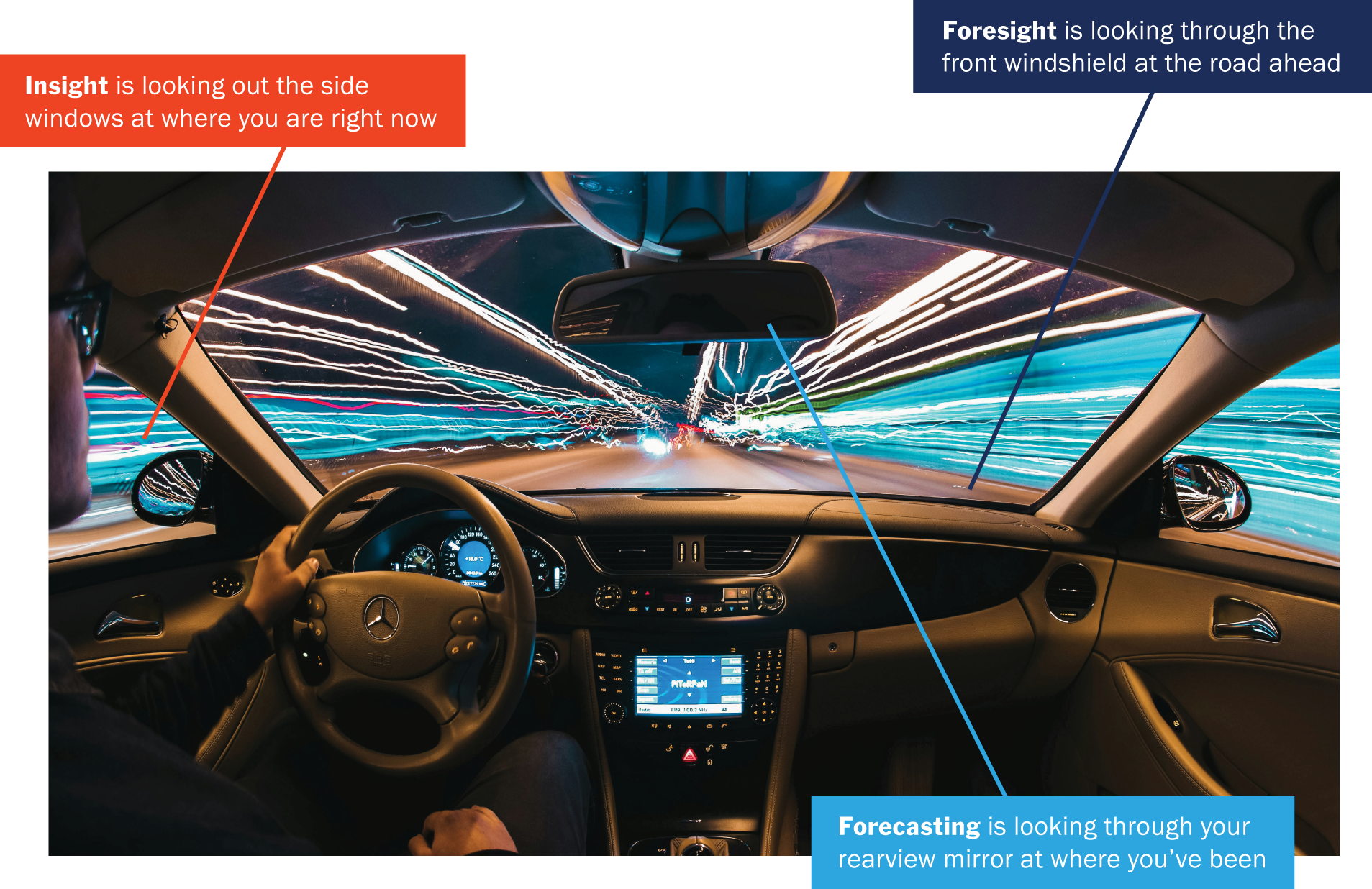
There’s a reason the windshield dominates your view: looking behind and beside you will never show you what’s coming. Every business needs all three views, but only foresight prepares you for a world that hasn’t yet arrived.
The Cost of Flying Blind
Foresight matters because consumer beliefs are shifting, and social, technological, economic, environmental, and regulatory forces disrupt faster than ever. Past winners don’t always stay in the lead once the competition moves. The question worth asking isn’t “what will happen?” but rather “how do we grow based on what could happen?” If you skip that question, the costs compound quietly, then all at once. The organization starts making short-sighted, reactive decisions, and strategy turns into a string of urgent pivots. Organizations operating without foresight tend to fall into the same six traps:
OVER-INVESTING
Financial and human capital stay tied up in legacy products and growth models that no longer match demand.
CHASING HYPE
Copying whatever’s visible
right now, instead of building durable, differentiated platforms.
LETTING COMPETITORS
SET TERMS
Just as with BlackBerry, rivals set consumer expectations
and retailer standards before you get a chance to respond.
DILUTING BRAND EQUITY
Inconsistent communication
and random acts of innovation erode what the brand stands
for.
ERODING MARGIN
Falling behind market expectations forces you to compete on price, steadily eroding profitability and business value.
Absent anticipation and planning, regulatory, supply,
and reputational risks become heightened.
Preparation Over Prediction
Future planning is often neglected because teams are rewarded on short-term wins and bonuses aren’t tied to next decade’s performance. That reflex only worsens in an economic downturn, when innovation and long-term strategy are often deprioritized. This is a fatal mistake. If organizations focus entirely on surviving the present, the world moves on, leaving it miles behind when the market rebounds.
The opportunity is to double down when others retreat.
That said, foresight doesn’t promise prediction, and nobody has a crystal ball. The goal is to prepare by taking actions today that position businesses and brands to win across a range of plausible futures, rather than betting everything on a single one.
Where Foresight Earns It's Keep
The best organizations don’t treat foresight as a one-time deliverable. They build it as an ongoing muscle and mindset, integrating forward-looking intelligence across the enterprise:
INNOVATION
Fuels the long-range pipeline, giving R&D a view of needs and demand drivers 2-10 years out.
BRAND STRATEGY
Shapes positioning based on where consumers, culture, and categories are headed, not where they’ve been.
CORPORATE STRATEGY
Aligns leadership and the board around a shared, evidence-based view of what’s next.
CATEGORY VISIONING
Strengthens conversations with retail partners looking for a supplier who can see around corners.
RISK MITIGATION
Surfaces regulatory, supply-chain, and reputational exposure before it becomes a crisis.
CAPABILITIES
Modernizes operating models and organizational structures to adapt to changing category dynamics.
While foresight can be leveraged across different functions, it employs the same underlying mindset: replace assumptions about the future with evidence and provide the organization with a shared language and vision for what’s next. When leadership agrees on what the future might look like, you can build a business that knows how to get there.
Why Now? Are You Prepared?
The future isn’t waiting for your next strategic planning cycle. Consumer and macro shifts are rewriting the rules of business while most organizations are busy optimizing today’s playbook.
At Seurat Group, our team is constantly scanning emerging signals of change and anticipating future shifts. Among the many forces on our radar, five stand out with strong potential to reshape consumer behavior, cultural values, and market dynamics.
Spotting Change: Five Emerging Realities Disrupting Your Growth Strategy
1. Digital Disobedience:
People are shifting from temporary digital detoxes to more active cognitive rebellion. To restore attention spans and escape algorithmic profiling, consumers are rejecting micro-content, poisoning their own data trails, and pursuing niche subcultures over curated personas. Why It Matters: Brands will need to look beyond algorithms and digital channels to meaningfully understand and reach digitally disobedient consumers.
2. Financial Rebellion:
As the promise of the American dream slips out of reach, younger generations are ditching the traditional financial playbook. Driven by a desire to game the system, their appetite for high-risk, high-reward plays—from crypto to sports betting and prediction markets—is redefining what it means to live, spend, and save. Why It Matters: Brands will fail to engage younger generations if they sell traditional value to a cohort spending and saving differently than their parents.
3. Synthetic Socialization:
People are substituting human relationships with zero-friction connections, relying on personal AI and parasocial creator bonds for closeness. While synthetic intimacy eliminates the risk of vulnerability, this reliance will accelerate solo lifestyles and deepen loneliness and social isolation. Why It Matters: Brands will need to either adapt to the realities of an increasingly solo consumer or help facilitate experiences for deeper human connection.
4. Anti-Wellness:
People are starting to shed overly optimized habits and rigid wellness routines to reclaim joy and messiness. Exhausted by health metrics, biohacking, and “protein-maxxed” diets, consumers will prioritize unapologetic pleasure over performative wellness. Why It Matters: Brands that fixate on wellness and optimization will lose relevance among consumers craving a more rewarding, joyful type of fulfillment.
5. Certified Human:
As hyper-convenience, automation, and AI “slop” saturate daily life, people are placing a premium on the value of human effort. From seeking out human-first experiences to raw creativity, value will continue to shift from immediacy to imperfection and the undeniable proof of human craft. Why It Matters: As convenience becomes commoditized, more brands will need to spotlight human effort to defend their price premium.
Which of these five shifts are you actively preparing for, and which are sitting in your blind spot?
Seurat helps businesses turn these emerging risks and opportunities into prioritized actions, yielding clear strategic pathways to navigating the future.
Where to Start?
Every business is already making bets on the future. Seurat arms clients with a clear, evidence-based view of what’s coming—and a strategy built to win in whichever future arrives.
The future is already here. Let’s make sure you’re ready for it.
Interested in what the future means for your buisiness?
Let’s talk foresight: info@seuratgroup.com
Recent Comments