
The Right Tool for the Job
A Framework for Using Segmentations & Demand Maps
The insights professional’s toolkit has never been more powerful: with advancements in both methodology and technology, researchers now have an unprecedented ability to build broad and deep understanding of consumers and their needs—ultimately to help businesses reach the right consumers with the right messages at the right times. Segmentations and demand maps are two of the most common tools for doing this, but unfortunately, too often these studies are commissioned as “boxes to check,” with one tool selected reflexively — or the two treated as competitors — rather than as complementary lenses calibrated to a market’s actual structure. This paper offers a practical framework for determining how to weight and combine the two so they unlock the greatest strategic leverage.
Two Tools, Two Lenses
Consumer segmentations and demand maps both bring structure to a market, but they’re designed to explain fundamentally different kinds of variation.
A consumer segmentation is designed to explain variation in the who. It segments a market according to who people are — their attitudes, behaviors, lifestyles, values, and needs as individuals. The unit of analysis is the consumer. The goal is to identify clusters of “like” people that are meaningfully different in ways that affect how they engage with a category—and, frequently, to prioritize one or more segments that are most attractive to a business.
A demand map is designed to explain variation in the why. It segments a market by why, when and/or how people consume — the jobs to be done, the emotional and functional needs at play, and the contexts in which consumption occurs. The unit of analysis is the occasion or demand moment. The goal is to reveal the architecture of consumption across a category—and, often, to prioritize a subset of demand moments for which a business has an outsized right to win.
The Variance Framework
Think of your market as having two primary dimensions along which structure can exist:
Consumer Variance: How different are the people in your category from one another in ways that matter to your brand — their needs, motivations, lifestyles, and category relationships?
Demand Variance: How different are the occasions and need states that drive consumption — the contexts, emotional drivers, and functional jobs that the category serves across different moments?
Evaluating your market on these two dimensions reveals where it sits along a spectrum. In practice, few markets sit purely at one extreme. Most have real structure on both dimensions — the question is which is more pronounced, and therefore which lens should lead. Rather than a binary choice, think of segmentation and demand mapping as anchoring two ends of a spectrum, with most markets falling somewhere between:
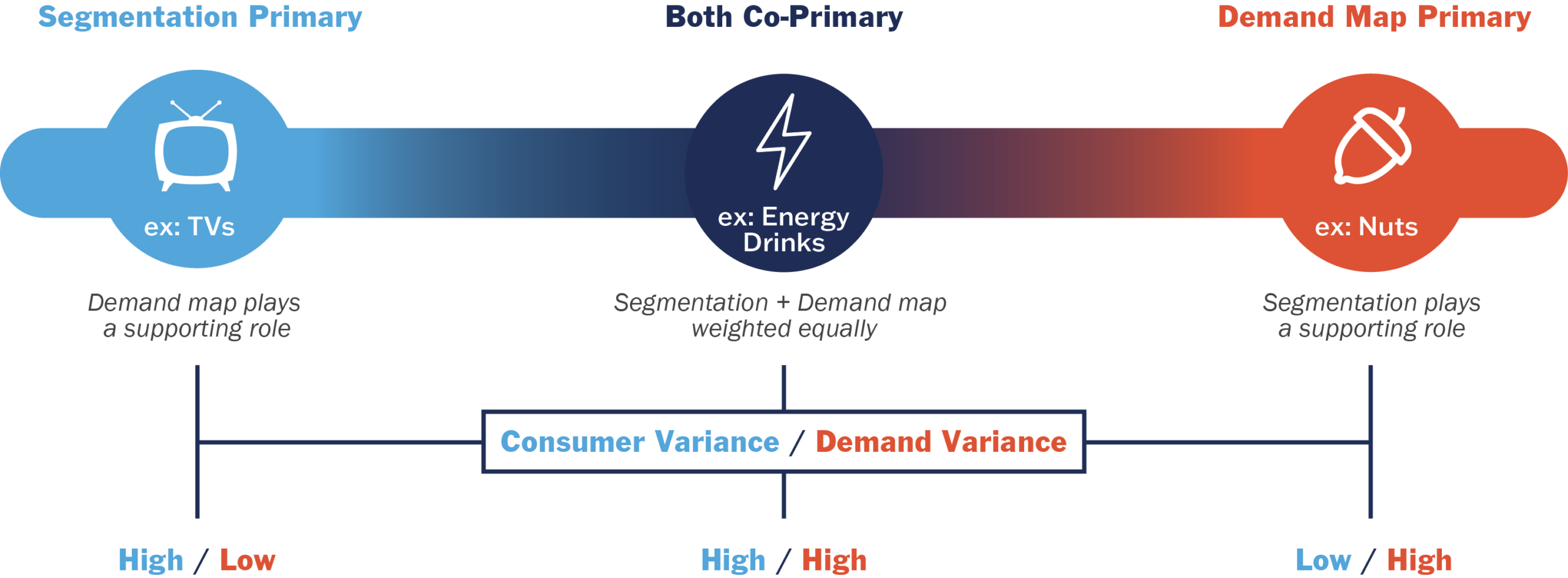
Wherever your market falls, the secondary lens is rarely wasted effort — it adds texture and precision to the primary lens rather than standing on its own. The question is one of emphasis and sequencing, not exclusion.
Reading the Spectrum
Segmentation as the Primary Lens
Segmentation should lead when consumption occasions are broadly consistent but the people consuming are markedly different. The category reliably serves a similar set of needs — but who shows up, and how they evaluate options, varies considerably. Here, a demand map plays a supporting role: rather than anchoring the strategy, it adds texture to how each segment engages with whatever occasion variance exists.
Consider TVs. Entertainment preferences aside, the demand occasion is relatively homogenous: a consumer is buying a screen to watch content, and it doesn’t much matter whether that screen goes in a living room, a bedroom, or a basement. The functional need is consistent across contexts. However, consumers are anything but uniform. A tech enthusiast obsessing over refresh rates and HDR standards occupies a completely different decision space than a price-conscious buyer seeking something affordable and no-frills. While a demand map would add little here, a well-crafted segmentation can shape go-to-market strategy, guide feature prioritization, and sharpen media investment. A lightweight pass at demand occasions can still sharpen the margins — knowing that the tech enthusiast is often shopping for a dedicated home-theater setup while the price-conscious buyer is furnishing a spare bedroom helps tailor messaging and channel within each segment — but it remains a supporting layer, not the primary architecture.
Demand Mapping as the Primary Lens
Demand mapping should lead when the consumer base is relatively homogenous but consumption occasions span a wide range of contexts, functional needs, and emotional drivers. The insight is less about who your consumers are and more about what they want or need in any given moment — though a secondary segmentation lens can bring clarity to marketing and communication strategy, informed by which consumers over-index on specific occasions.
Nuts offer a compelling example. Nut buyers may look different across life stage, ethnicity, household income or health & wellness orientation. However, understanding these variances does less to inform how to grow the market. Demand variance, by contrast, is significant. A consumer reaching for nuts as a between-meal snack has a different set of priorities than one choosing them as a baking ingredient, adding them as a salad topper, stirring them into oatmeal, or processing them into nut butter. Each use case implies different product formats, pack sizes, flavor profiles, price tolerances—and even in-store placement (e.g., baking aisle vs. produce department). While a segmentation alone might miss this nuance, a demand map built around the full range of use occasions should lead here, providing business owners with a framework to guide portfolio design, packaging decisions, merchandising guidelines, and occasion-specific messaging. A secondary consumer lens still adds value: knowing which cohorts over-index with which occasions can inform where and how brands “show up” and ensure messaging resonates.
Both Tools Used Together
Meaningful variance in both dimensions signals a genuinely complex market — one where neither tool alone fully captures the strategic landscape, and where the two sit at the midpoint of the spectrum. Both are warranted, and they work best together, independently segmenting consumers and demand moments and then superimposing these two lenses for a holistic view.
Energy Drinks illustrate this complexity well. Consumer variance is high: attitudes vary meaningfully toward sugar and certain ingredients, as do brand preferences (e.g., legacy mainstays vs. better-for-you challengers) and price sensitivity. These differences define fundamentally distinct ways in which consumers interact with the category.
Demand variance is equally rich. In one moment, a consumer might want a quick, intense caffeine jolt to power through a late-night work session — a high-intensity, functional occasion where format and speed of effect matter most. In another, the same consumer might want a steadier, more sustained state of calm focus. Some occasions warrant a refreshing and hydrating flavor profile that’s easy to drink quickly; others may call for something more indulgent, meant to be sipped or savored over time. Each need state or occasion calls for a different set of product attributes and reasons to believe—which are often correlated with channel (e.g., a single can purchased on-the-go at a convenience store vs. a multi-pack purchased for pantry stocking in the Club channel). A segmentation without a demand map would miss this nuance. Similarly, a demand map without a segmentation loses sight of which consumers are driving which occasions — and which are most valuable to the brand. Together they provide the full picture.
Diagnosing Your Market:
Questions to Ask Before You Commission
In summary, choosing the right tools starts with understanding where the most meaningful variance in your market lives.
Where does the meaningful variance in your market actually live — across consumers, across demand occasions, or both?
Before proceeding, ask yourself the following:
On consumer variance: When you look across your category users, do you see meaningfully different relationships with the category — different emotional drivers, different identities tied to the category, different behavioral profiles? Or does the consumer base feel relatively uniform?
On demand variance: Does the category get used in a wide range of contexts and for a wide range of reasons? Are the functional and emotional needs in one occasion genuinely different from those in another? Or are the need states relatively consistent across consumption moments?
On existing knowledge: What do you already know? If you have a recent, robust segmentation but no demand framework, the incremental return from another segmentation is low. Fill the gap in your market understanding.
On the strategic question at hand: What decision is this research intended to inform? Portfolio architecture and packaging decisions often call for demand mapping to lead. Brand positioning and targeting decisions often call for segmentation to lead. Let the decision drive which lens leads — and which plays a supporting role.
Questions to Ask Before You Commission
Calibrating the right mix of segmentation and demand mapping is one of the highest-leverage decisions an insights leader makes. Done well, it aligns your entire organization around a common language for understanding consumers and demand — and it focuses research investment where it will generate the most strategic return.
Interested in exploring the best approach for your category?
We’d love to continue the conversation: info@seuratgroup.com

Recent Comments