The Future Belongs to Brands That See It First

The Future Belongs to Brands That See It First

The Future Belongs to Brands That See It First

Why today’s forecast misses tomorrow’s shifts & how foresight reveals the blind spots in your strategy 

In 2007, BlackBerry controlled nearly half of the U.S. mobile market. When the iPhone launched that same year, BlackBerry dismissed it as a fragile gadget with no keyboard and weak security. Android joined the race in 2008, but BlackBerry didn’t release a competitive touchscreen device until 2013. By then, BlackBerry’s market share had collapsed to under 4% in the U.S.

BlackBerry wasn’t bad at making phones. It failed because it ignored the early signals of a fundamental market transformation:

Shifting identity and culture: Mobile devices were evolving from corporate work tools into expressive extensions of personal identity, status, and lifestyle.

Emerging interface innovation: Consumers were quick to embrace more intuitive, touch-first interactions over keyboard messaging.

New business models: Value expanded from selling standalone hardware to connected ecosystems pairing devices with content, apps, and other digital services.

Focused on executing day-to-day operations, BlackBerry failed to anticipate what was coming next. By the time leadership finally looked up, the market had already moved on. Most strategic plans make the same mistake. They extrapolate past successes and tweak at the margins. That approach holds up only when the future resembles the past, and it breaks the moment the landscape changes. Today, these shifts arrive faster than ever. Look at the CPG industry: challenger brands are seizing category share and redefining growth.

This is the gap that foresight is built to close.

From Insight to Foresight

Insight explains what people want, feel, and need today, giving businesses a clear picture of the present. Forecasting takes historical data and projects it forward—reliable when conditions are slow, stable, and predictable, but brittle when they’re not. Insights and forecasts often exist in a vacuum, because consumer needs don’t change in isolation. They are shaped by external forces like technological shifts, economic pressures, and cultural swings. While insights explain why something is happening right now, and forecasts project forward what has happened in the past, foresight connects the dots between signals of change to anticipate shifts that will impact future habits, mindsets, and expectations. Think of it like driving a car:
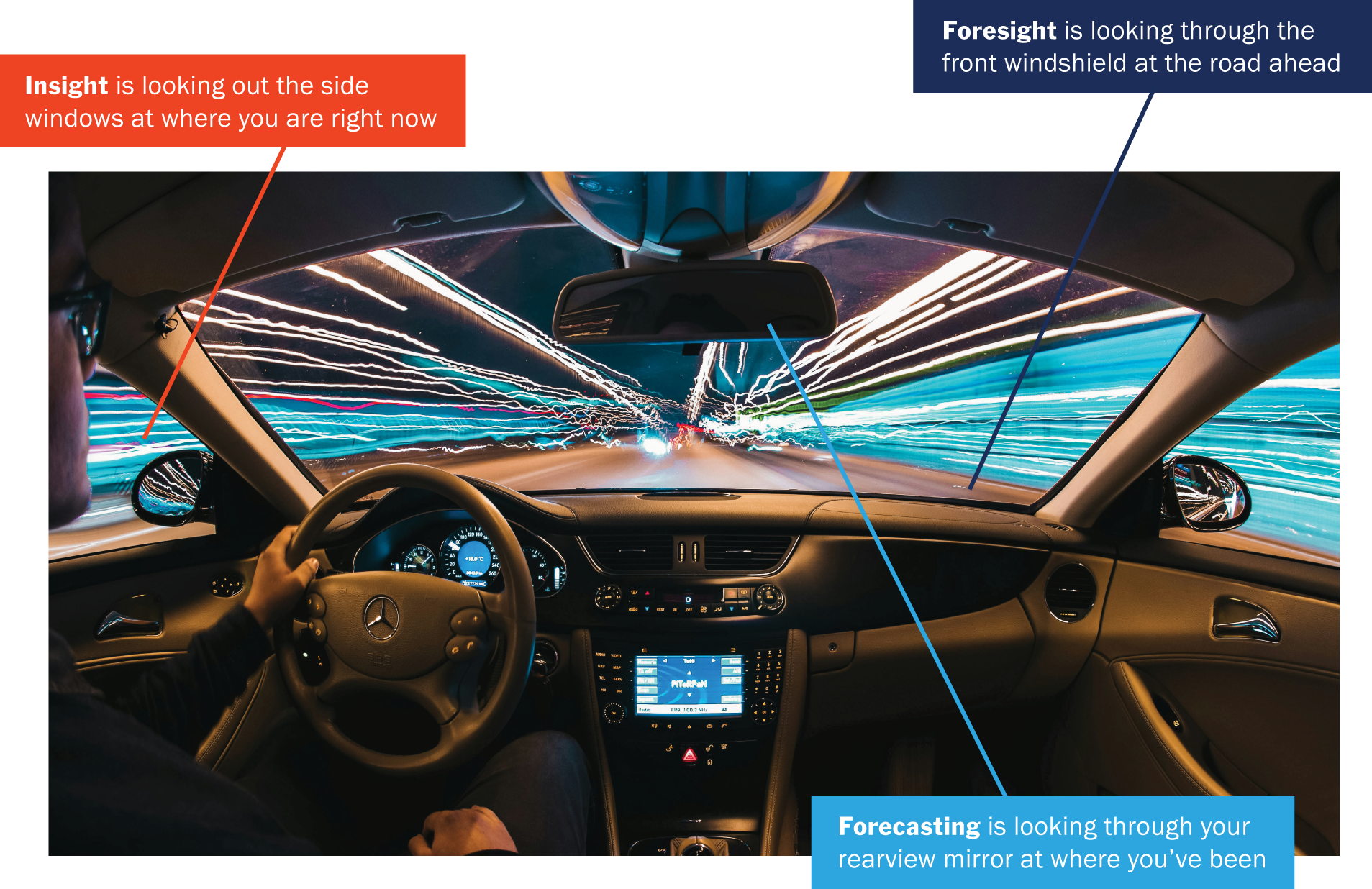
There’s a reason the windshield dominates your view: looking behind and beside you will never show you what’s coming. Every business needs all three views, but only foresight prepares you for a world that hasn’t yet arrived.

The Cost of Flying Blind

Foresight matters because consumer beliefs are shifting, and social, technological, economic, environmental, and regulatory forces disrupt faster than ever. Past winners don’t always stay in the lead once the competition moves. The question worth asking isn’t “what will happen?” but rather “how do we grow based on what could happen?” If you skip that question, the costs compound quietly, then all at once. The organization starts making short-sighted, reactive decisions, and strategy turns into a string of urgent pivots. Organizations operating without foresight tend to fall into the same six traps:

OVER-INVESTING
Financial and human capital stay tied up in legacy products and growth models that no longer match demand.

CHASING HYPE
Copying whatever’s visible
right now, instead of building durable, differentiated platforms.

LETTING COMPETITORS
SET TERMS

Just as with BlackBerry, rivals set consumer expectations
and retailer standards before you get a chance to respond.

DILUTING BRAND EQUITY
Inconsistent communication
and random acts of innovation erode what the brand stands
for.

ERODING MARGIN
Falling behind market expectations forces you to compete on price, steadily eroding profitability and business value.

REMAINING EXPOSED TO VOLATILITY
Absent anticipation and planning, regulatory, supply,
and reputational risks become heightened.

Preparation Over Prediction

Future planning is often neglected because teams are rewarded on short-term wins and bonuses aren’t tied to next decade’s performance. That reflex only worsens in an economic downturn, when innovation and long-term strategy are often deprioritized. This is a fatal mistake. If organizations focus entirely on surviving the present, the world moves on, leaving it miles behind when the market rebounds.

The opportunity is to double down when others retreat.

That said, foresight doesn’t promise prediction, and nobody has a crystal ball. The goal is to prepare by taking actions today that position businesses and brands to win across a range of plausible futures, rather than betting everything on a single one.

Where Foresight Earns It's Keep

The best organizations don’t treat foresight as a one-time deliverable. They build it as an ongoing muscle and mindset, integrating forward-looking intelligence across the enterprise:

INNOVATION
Fuels the long-range pipeline, giving R&D a view of needs and demand drivers 2-10 years out.

BRAND STRATEGY
Shapes positioning based on where consumers, culture, and categories are headed, not where they’ve been.

CORPORATE STRATEGY
Aligns leadership and the board around a shared, evidence-based view of what’s next.

CATEGORY VISIONING
Strengthens conversations with retail partners looking for a supplier who can see around corners.

RISK MITIGATION
Surfaces regulatory, supply-chain, and reputational exposure before it becomes a crisis.

CAPABILITIES
Modernizes operating models and organizational structures to adapt to changing category dynamics.

While foresight can be leveraged across different functions, it employs the same underlying mindset: replace assumptions about the future with evidence and provide the organization with a shared language and vision for what’s next. When leadership agrees on what the future might look like, you can build a business that knows how to get there.

Why Now? Are You Prepared?

The future isn’t waiting for your next strategic planning cycle. Consumer and macro shifts are rewriting the rules of business while most organizations are busy optimizing today’s playbook.

At Seurat Group, our team is constantly scanning emerging signals of change and anticipating future shifts. Among the many forces on our radar, five stand out with strong potential to reshape consumer behavior, cultural values, and market dynamics.

Spotting Change: Five Emerging Realities Disrupting Your Growth Strategy

1. Digital Disobedience:
People are shifting from temporary digital detoxes to more active cognitive rebellion. To restore attention spans and escape algorithmic profiling, consumers are rejecting micro-content, poisoning their own data trails, and pursuing niche subcultures over curated personas. Why It Matters: Brands will need to look beyond algorithms and digital channels to meaningfully understand and reach digitally disobedient consumers.

2. Financial Rebellion:
As the promise of the American dream slips out of reach, younger generations are ditching the traditional financial playbook. Driven by a desire to game the system, their appetite for high-risk, high-reward plays—from crypto to sports betting and prediction markets—is redefining what it means to live, spend, and save. Why It Matters: Brands will fail to engage younger generations if they sell traditional value to a cohort spending and saving differently than their parents.

3. Synthetic Socialization:
People are substituting human relationships with zero-friction connections, relying on personal AI and parasocial creator bonds for closeness. While synthetic intimacy eliminates the risk of vulnerability, this reliance will accelerate solo lifestyles and deepen loneliness and social isolation.
Why It Matters: Brands will need to either adapt to the realities of an increasingly solo consumer or help facilitate experiences for deeper human connection.

4. Anti-Wellness:
People are starting to shed overly optimized habits and rigid wellness routines to reclaim joy and messiness. Exhausted by health metrics, biohacking, and “protein-maxxed” diets, consumers will prioritize unapologetic pleasure over performative wellness.
Why It Matters: Brands that fixate on wellness and optimization will lose relevance among consumers craving a more rewarding, joyful type of fulfillment.

5. Certified Human:
As hyper-convenience, automation, and AI “slop” saturate daily life, people are placing a premium on the value of human effort. From seeking out human-first experiences to raw creativity, value will continue to shift from immediacy to imperfection and the undeniable proof of human craft.
Why It Matters: As convenience becomes commoditized, more brands will need to spotlight human effort to defend their price premium.

Which of these five shifts are you actively preparing for, and which are sitting in your blind spot?
Seurat helps businesses turn these emerging risks and opportunities into prioritized actions, yielding clear strategic pathways to navigating the future.

Where to Start?

Every business is already making bets on the future. Seurat arms clients with a clear, evidence-based view of what’s coming—and a strategy built to win in whichever future arrives.

The future is already here. Let’s make sure you’re ready for it.

Interested in what the future means for your buisiness?
Let’s talk foresight: info@seuratgroup.com
The Right Tool for the Job

The Right Tool for the Job

The Right Tool for the Job

A Framework for Using Segmentations & Demand Maps

The insights professional’s toolkit has never been more powerful: with advancements in both methodology and technology, researchers now have an unprecedented ability to build broad and deep understanding of consumers and their needs—ultimately to help businesses reach the right consumers with the right messages at the right times. Segmentations and demand maps are two of the most common tools for doing this, but unfortunately, too often these studies are commissioned as “boxes to check,” with one tool selected reflexively — or the two treated as competitors — rather than as complementary lenses calibrated to a market’s actual structure. This paper offers a practical framework for determining how to weight and combine the two so they unlock the greatest strategic leverage.

Two Tools, Two Lenses

Consumer segmentations and demand maps both bring structure to a market, but they’re designed to explain fundamentally different kinds of variation.

A consumer segmentation is designed to explain variation in the who. It segments a market according to who people are — their attitudes, behaviors, lifestyles, values, and needs as individuals. The unit of analysis is the consumer. The goal is to identify clusters of “like” people that are meaningfully different in ways that affect how they engage with a category—and, frequently, to prioritize one or more segments that are most attractive to a business.

A demand map is designed to explain variation in the why. It segments a market by why, when and/or how people consume — the jobs to be done, the emotional and functional needs at play, and the contexts in which consumption occurs. The unit of analysis is the occasion or demand moment. The goal is to reveal the architecture of consumption across a category—and, often, to prioritize a subset of demand moments for which a business has an outsized right to win.

The Variance Framework

Think of your market as having two primary dimensions along which structure can exist:

Consumer Variance: How different are the people in your category from one another in ways that matter to your brand — their needs, motivations, lifestyles, and category relationships?

Demand Variance: How different are the occasions and need states that drive consumption — the contexts, emotional drivers, and functional jobs that the category serves across different moments?

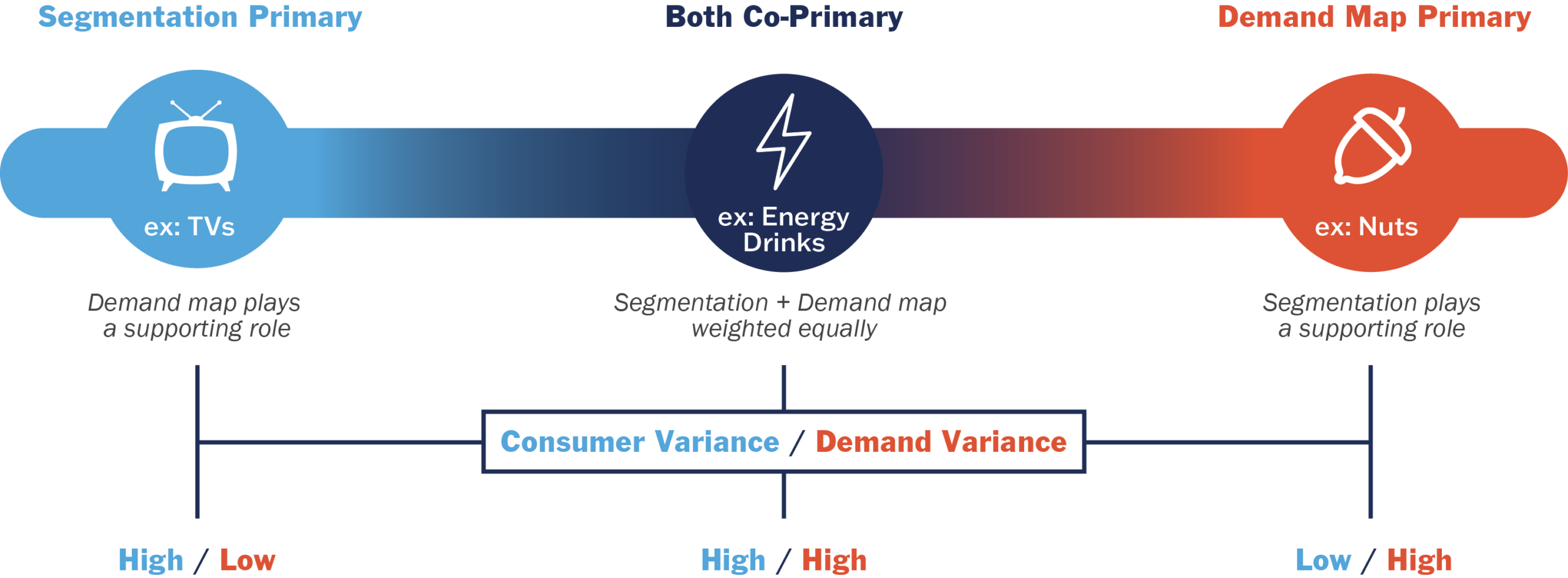
Evaluating your market on these two dimensions reveals where it sits along a spectrum. In practice, few markets sit purely at one extreme. Most have real structure on both dimensions — the question is which is more pronounced, and therefore which lens should lead. Rather than a binary choice, think of segmentation and demand mapping as anchoring two ends of a spectrum, with most markets falling somewhere between:

Wherever your market falls, the secondary lens is rarely wasted effort — it adds texture and precision to the primary lens rather than standing on its own. The question is one of emphasis and sequencing, not exclusion.

Reading the Spectrum

Segmentation as the Primary Lens

Segmentation should lead when consumption occasions are broadly consistent but the people consuming are markedly different. The category reliably serves a similar set of needs — but who shows up, and how they evaluate options, varies considerably. Here, a demand map plays a supporting role: rather than anchoring the strategy, it adds texture to how each segment engages with whatever occasion variance exists.

Consider TVs. Entertainment preferences aside, the demand occasion is relatively homogenous: a consumer is buying a screen to watch content, and it doesn’t much matter whether that screen goes in a living room, a bedroom, or a basement. The functional need is consistent across contexts. However, consumers are anything but uniform. A tech enthusiast obsessing over refresh rates and HDR standards occupies a completely different decision space than a price-conscious buyer seeking something affordable and no-frills. While a demand map would add little here, a well-crafted segmentation can shape go-to-market strategy, guide feature prioritization, and sharpen media investment. A lightweight pass at demand occasions can still sharpen the margins — knowing that the tech enthusiast is often shopping for a dedicated home-theater setup while the price-conscious buyer is furnishing a spare bedroom helps tailor messaging and channel within each segment — but it remains a supporting layer, not the primary architecture.

Demand Mapping as the Primary Lens

Demand mapping should lead when the consumer base is relatively homogenous but consumption occasions span a wide range of contexts, functional needs, and emotional drivers. The insight is less about who your consumers are and more about what they want or need in any given moment — though a secondary segmentation lens can bring clarity to marketing and communication strategy, informed by which consumers over-index on specific occasions.

Nuts offer a compelling example. Nut buyers may look different across life stage, ethnicity, household income or health & wellness orientation. However, understanding these variances does less to inform how to grow the market. Demand variance, by contrast, is significant. A consumer reaching for nuts as a between-meal snack has a different set of priorities than one choosing them as a baking ingredient, adding them as a salad topper, stirring them into oatmeal, or processing them into nut butter. Each use case implies different product formats, pack sizes, flavor profiles, price tolerances—and even in-store placement (e.g., baking aisle vs. produce department). While a segmentation alone might miss this nuance, a demand map built around the full range of use occasions should lead here, providing business owners with a framework to guide portfolio design, packaging decisions, merchandising guidelines, and occasion-specific messaging. A secondary consumer lens still adds value: knowing which cohorts over-index with which occasions can inform where and how brands “show up” and ensure messaging resonates.

Both Tools Used Together

Meaningful variance in both dimensions signals a genuinely complex market — one where neither tool alone fully captures the strategic landscape, and where the two sit at the midpoint of the spectrum. Both are warranted, and they work best together, independently segmenting consumers and demand moments and then superimposing these two lenses for a holistic view.

Energy Drinks illustrate this complexity well. Consumer variance is high: attitudes vary meaningfully toward sugar and certain ingredients, as do brand preferences (e.g., legacy mainstays vs. better-for-you challengers) and price sensitivity. These differences define fundamentally distinct ways in which consumers interact with the category.

Demand variance is equally rich. In one moment, a consumer might want a quick, intense caffeine jolt to power through a late-night work session — a high-intensity, functional occasion where format and speed of effect matter most. In another, the same consumer might want a steadier, more sustained state of calm focus. Some occasions warrant a refreshing and hydrating flavor profile that’s easy to drink quickly; others may call for something more indulgent, meant to be sipped or savored over time. Each need state or occasion calls for a different set of product attributes and reasons to believe—which are often correlated with channel (e.g., a single can purchased on-the-go at a convenience store vs. a multi-pack purchased for pantry stocking in the Club channel). A segmentation without a demand map would miss this nuance. Similarly, a demand map without a segmentation loses sight of which consumers are driving which occasions — and which are most valuable to the brand. Together they provide the full picture.

Diagnosing Your Market:

Questions to Ask Before You Commission

In summary, choosing the right tools starts with understanding where the most meaningful variance in your market lives.

Where does the meaningful variance in your market actually live — across consumers, across demand occasions, or both?

Before proceeding, ask yourself the following:

On consumer variance: When you look across your category users, do you see meaningfully different relationships with the category — different emotional drivers, different identities tied to the category, different behavioral profiles? Or does the consumer base feel relatively uniform?

On demand variance: Does the category get used in a wide range of contexts and for a wide range of reasons? Are the functional and emotional needs in one occasion genuinely different from those in another? Or are the need states relatively consistent across consumption moments?

On existing knowledge: What do you already know? If you have a recent, robust segmentation but no demand framework, the incremental return from another segmentation is low. Fill the gap in your market understanding.

On the strategic question at hand: What decision is this research intended to inform? Portfolio architecture and packaging decisions often call for demand mapping to lead. Brand positioning and targeting decisions often call for segmentation to lead. Let the decision drive which lens leads — and which plays a supporting role.

Questions to Ask Before You Commission

Calibrating the right mix of segmentation and demand mapping is one of the highest-leverage decisions an insights leader makes. Done well, it aligns your entire organization around a common language for understanding consumers and demand — and it focuses research investment where it will generate the most strategic return.

Interested in exploring the best approach for your category?
We’d love to continue the conversation: info@seuratgroup.com

Building Unreasonable Loyalty

Building Unreasonable Loyalty

Building Unreasonable Loyalty

CPG companies spend a lot of time trying to cultivate loyalty. They launch affinity-driving campaigns, track purchase rates over time, field A&Us, measure Net Promoter Score, and monitor engagement metrics across channels—all in service of winning a disproportionate share of consumers’ minds and wallets. And yet, if you subscribe to Byron Sharp’s How Brands Grow philosophy, loyalty is virtually nonexistent; the only real way to grow is through penetration. Are marketers wasting their time?

In industries like travel, hospitality and financial services, firms use rewards programs to create loyalty “beyond reason.” (Consider the choice of saving $200 on a flight or earning Platinum medallion status.) These companies tend to own customer relationships, a dynamic that affords them first-party data, richer branded experiences and the ability to control the message. With CPG brands, scaling beyond a certain point typically means relinquishing control. Absent a direct relationship, their brand story loses fidelity, and they exist at the mercy of the merchant.

And yet, some brands manage to transcend this dynamic. Despite disintermediation and with no subscription plans or fancy tiered rewards programs, a select few manage to achieve what can only be considered “unreasonable loyalty”—that is, they win consumer choice even when cheaper and more readily available alternatives exist. They simultaneously grow both penetration and share of wallet. We set out to understand how these brands cultivate unreasonable loyalty and identified a set of core principles brand builders at any stage can apply.

Achieving unreasonable loyalty comes down to three things:

Sometimes unreasonable loyalty boils down to delivering an experience that competitors simply can’t replicate. That experience could be sensory (e.g., a proprietary taste or texture), aesthetic (e.g., a visual and/or design experience that makes alternatives feel like a sacrifice) or functional (e.g., a product that works demonstrably better than anything else or ‘locks you in’ based on habit or ease).

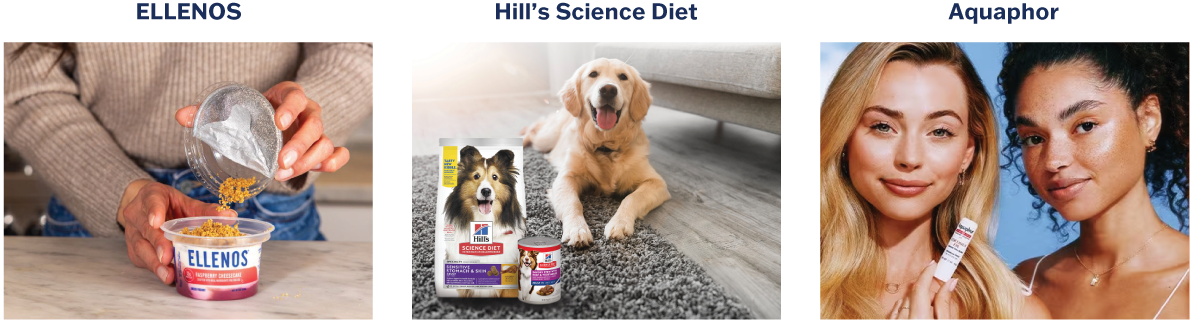
ELLENOS is Greek yogurt with a creamy texture and mouthfeel that’s unrivaled in the category. It’s closer to Italian gelato than it is Fage, which helps explain the dessert recipes on the brand’s website and food porn on Instagram. This unique sensory experience allows ELLENOS to command a hefty premium: at $3.99 per tub, it’s more than twice the price of Chobani on a per ounce basis—and consumers are more than happy to pay up.

Hill’s Science Diet competes in dog food—not the sexy, fresh home-delivery meal kits, but brown, dry kibble. And yet, it has earned industry-leading pet parent loyalty through a combination of superior efficacy and high switching costs. Its proprietary ActivBiome+ innovation harnesses decades of scientific research to deliver noticeable immunity, digestion and vitality benefits. And once dogs eat it regularly, assuming they tolerate it well, there’s virtually no reason to ever switch. A 27.5-lb bag of Rx-grade Biome sells for $145 vs. $63 for Chewy’s private brand.

Aquaphor has built a reputation as a magic ointment, with “put some Aquaphor on it” being the go-to advice for everything from dry, cracked skin and minor scrapes and burns to diaper rash, pimples, dry cuticles and more. The product itself is just petroleum jelly that forms a breathable protective layer on the skin. But it’s a master class in building consumer loyalty and trust: a simple and safe ingredient profile, coupled with distinctive memory structures, dermatologist recommendation claim and word-of-mouth efficacy has helped fuel sustained double-digit growth for Beiersdorf’s Derma division.

Other brands cultivate unreasonable loyalty by reinforcing consumers’ sense of identity. When brands become entrenched in identity, each purchase signals allegiance to a worldview—often to the point where switching can feel like a betrayal of self, rather than a shift in preference. This is valuable territory: the higher you go on Maslow’s hierarchy of needs, the greater your ability to develop deep emotional ties and command a meaningful premium.

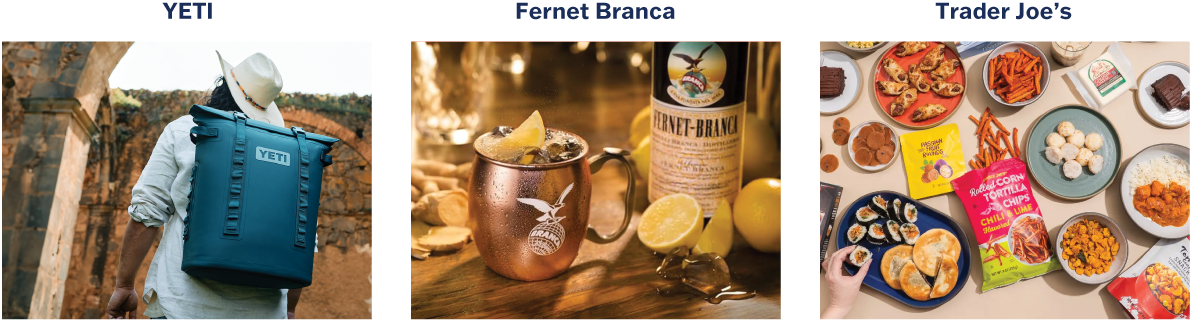
YETI doesn’t just sell coolers; it sells an aspirational lifestyle. Being seen with a YETI signals an ability to afford certain creature comforts (coolers can run upwards of $400) as well as participation in a rugged, suburban outdoorsy lifestyle. Loyalty comes not just from high quality products that work, but also from a deliberate focus on making buyers feel like the envy of the neighborhood—which spans everything from design to channel strategy and commitment to environmental stewardship.

Fernet Branca is an Italian amaro with a medicinal taste profile that’s proudly not for everyone. It’s powerfully bitter, with strong notes of menthol—not unlike a grownup Jägermeister. This profile, coupled with a storied Italian legacy and vintage design that looks great in dimly lit bars and restaurants, has earned it a reputation as a
“bartender’s handshake.” Ordering a Fernet signals one of two things: you’re either
a hospitality pro or an in-the-know consumer with highly discerning taste. Either way, this dynamic has propelled the brand north of $500MM, an impressive feat in a softening beverage alcohol market.

Trader Joe’s breaks nearly every rule in the grocery book. And yet, its formula of limited SKUs, majority private label products, constantly changing assortment and no discounting has created some of the industry’s most fiercely loyal shoppers. This playbook helps patrons signal that they’re savvy, value-conscious and a little less
“mainstream” in their tastes. The strategy helps explain why TJ’s boasts
industry-leading sales per square foot.

Brands also win unreasonable loyalty by building and facilitating community—appealing to consumers’ desire to belong to something larger than themselves. Some brands actively engage consumers in co-creating products and experiences; others simply invite them to participate in ways that make them feel more involved. The common thread: brand as a vehicle for human connection.

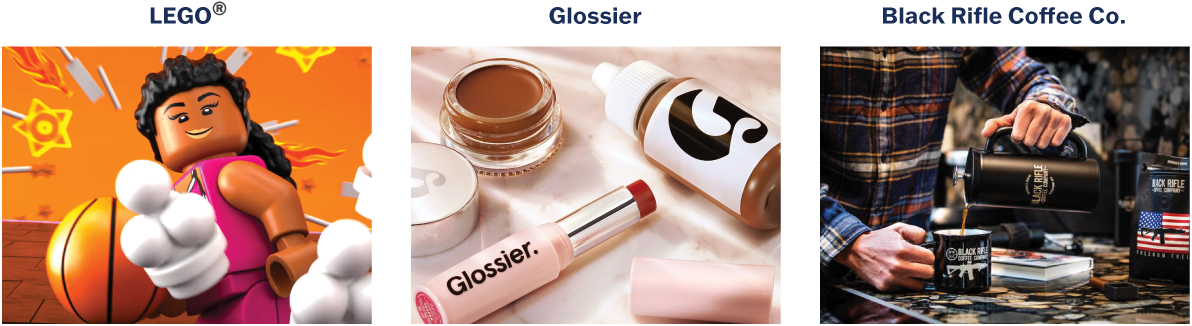
LEGO® cultivates community in a way that makes it look more like an entertainment company than a toy manufacturer. The brand uses a platform of creativity to give its intergenerational tribe of builders endless ways to connect, from in-person building events and digital forums to special edition fandom crossovers (Star Wars, Harry Potter, Marvel), TV & movie content (LEGO® Masters, The LEGO® Movie), theme parks and more. AFOL (“adult fan of LEGO®”) has even worked its way into the vernacular, further testament to the brand’s community-building power.

Glossier originated as “Into the Gloss,” a beauty blog by founder Emily Weiss, who harnessed that early, highly engaged audience to co-create the beauty brand it is today. Glossier nurtures community through a collaborative approach to brand building—iterating with consumers on product evolution & innovation, prioritizing real consumers over models in advertising, amplifying user-generated content and setting up retail stores as places to connect over shared experiences, rather than merely transact.

Black Rifle Coffee is a veteran-founded coffee company for “people who love America.” The brand is unequivocal and single-minded about its community across product naming, packaging design and its commitment to giving back to veterans, first responders, and men and women in uniform. This community is paying off: in a tough commodity category, Black Rifle grew net revenue 7% to $400MM in 2025 and scaled distribution to an impressive 55% ACV.

Looking across these examples, two things are clear about unreasonable loyalty. First, the most successful brands aren’t asking, “how do we keep you buying?” but rather, “how do we keep you believing?” Second, the secret isn’t owning the relationship—it’s owning the story consumers tell themselves. At scale, brands that crack this do it by finding channels—not retail channels, but cultural channels—where that story keeps getting reinforced.

Interested in exploring how your brand can cultivate unreasonable loyalty?
Let’s talk about what’s possible: Let’s discuss: info@seuratgroup.com.

Inside Expo West 2026: The Trends That Matter

Inside Expo West 2026: The Trends That Matter

Inside Expo West 2026: The Trends That Matter

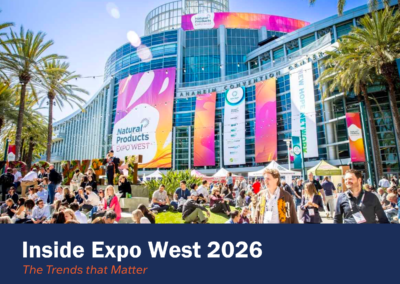
Each spring, Anaheim becomes the center of the CPG universe. Founders arrive with their passionate ideas, buyers hunt for the next breakout brand, and thousands of industry obsessives descend on Expo West to taste, debate, and trend-spot their way through the future of CPG. Team Seurat joined the fray once again this year—zig-zagging the halls of Expo West 2026 to scout the signals shaping the next wave of CPG. 

Of course, no Expo is complete without the unofficial currency of the show – the swag bags. This year’s contenders generated almost as much buzz as the products themselves, from Goyard-inspired totes to puffy Muscle Milk bags and Goodles collectible “Brand BFF” charm bracelets (yes, we proudly collected them all).

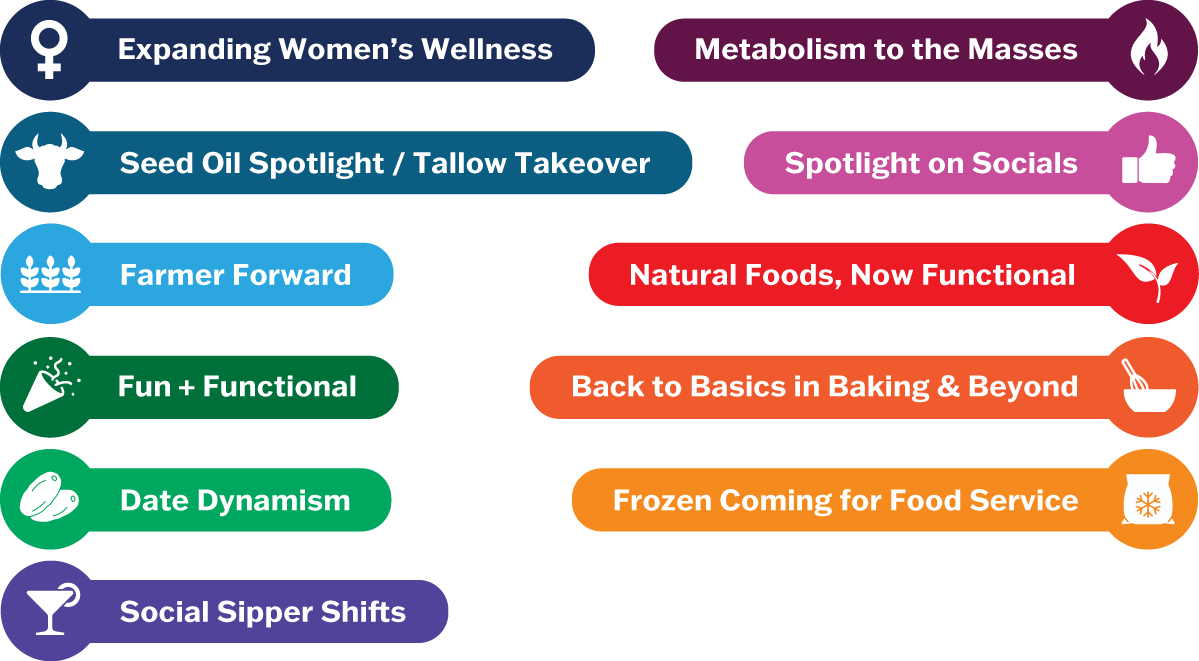
But beyond the tote bags and taste tests, Expo West remains the prime spot to take the pulse of where CPG is heading next. Many of the trends we identified last year are still going strong. The long-running protein parade marches on, taking on new and ever more creative forms. The Asian Frozen Feast has expanded into a broader frozen-versus-foodservice battle. And the “non-alc” space continues to evolve alongside shifting social rituals, building on the Mocktail Mojo we spotted. Several emerging themes have also clearly stepped into the spotlight — from the Great Animal Revival to Even Energy to what we’ve affectionately dubbed Honey, It’s Date Night. While we typically keep our roundup to a tidy top 10, this year Expo was extra – and so are we. So 11 trends it is. Here’s what we’re watching…

Expanding Women’s Wellness

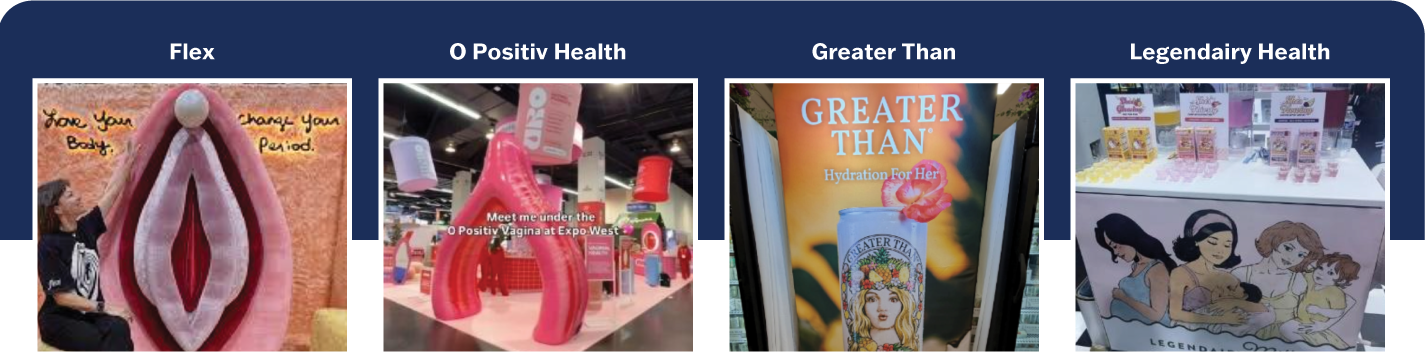
Women’s wellness wasn’t hiding at Expo West this year—it was on full display. From larger-than-life displays to boldly branded booths, women’s bodies and health needs were made overtly visible in a way that pushed stigma to the sidelines. The category no longer feels interested in whispering; instead, it is showing up with more confidence, candor, and cultural presence.

What felt especially notable was how far the conversation extended beyond period care. We saw solutions spanning adjustable menstrual discs, sexual wellness, and support for women across cycles and life stages—from pregnancy and breastfeeding to concerns like “mommy brain,” menopause, feminine balance, and hydration tailored to women’s needs. As awareness grows around the fact that women’s bodies have distinct needs—and that many of those needs have long been overlooked in a male-default world—brands across categories are beginning to respond more directly. What was once sidelined or simplified is increasingly being treated with greater specificity, nuance, and legitimacy.

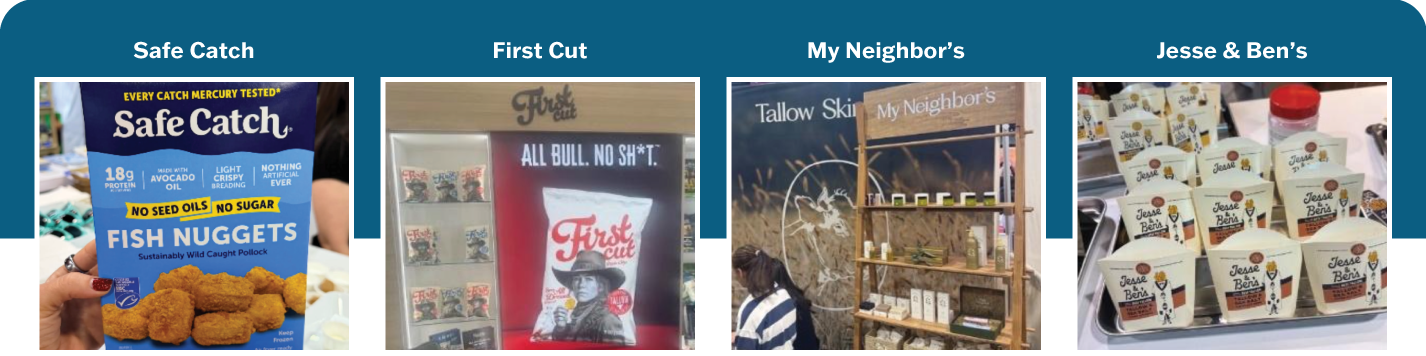
Seed Oil Spotlight / Tallow Takeover

You almost could have played punch buggy with “no seed oils” claims at Expo West this year. Across food and beverage, the callout was everywhere—showing up on everything from bars and chips to coffee creamers, and starting to feel like one of the defining badges of the show floor. More than just an ingredient claim, “no seed oils” often functioned as shorthand for cleaner, more trustworthy formulation.

At the same time, tallow was turning up in places that would have felt surprising not long ago, from chips to skincare, signaling a broader return to traditional fats. Beneath the headline-worthy claims is a bigger shift in how consumers are thinking about fat itself. As skepticism grows around industrial food systems and highly processed ingredients, more brands are tapping into the idea that older, more familiar fats may feel more natural, wholesome, and trustworthy. What once seemed like settled nutritional wisdom is now back on the table, with consumers reexamining which fats they want in their food—and even on their skin.

Tallow: 

No Seed Oils: 

Farmer Forward

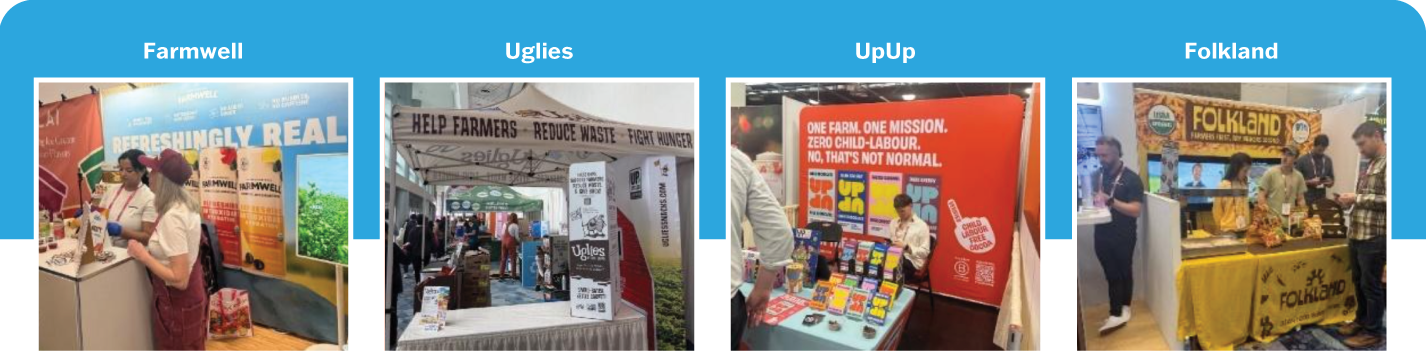
One word seemed to show up everywhere at Expo West this year: farmer. From booth signage to packaging to brand storytelling, brands leaned heavily into the people and places behind their products— highlighting farmer ownership, generational farms, regional sourcing, and closer connections between growers and consumers. Across categories, the emphasis was not just on what the product was, but on who grew it, where it came from, and the land it came from.

Connection to food is increasingly being built through stories of origin, the people who grow it, and the land it comes from. In a landscape where modern food systems can feel abstract and far removed, these cues help make products feel more grounded, transparent, and trustworthy. The result is a subtle but meaningful shift—from anonymous ingredients to food that feels rooted in real people and real places.

Fun & Functional

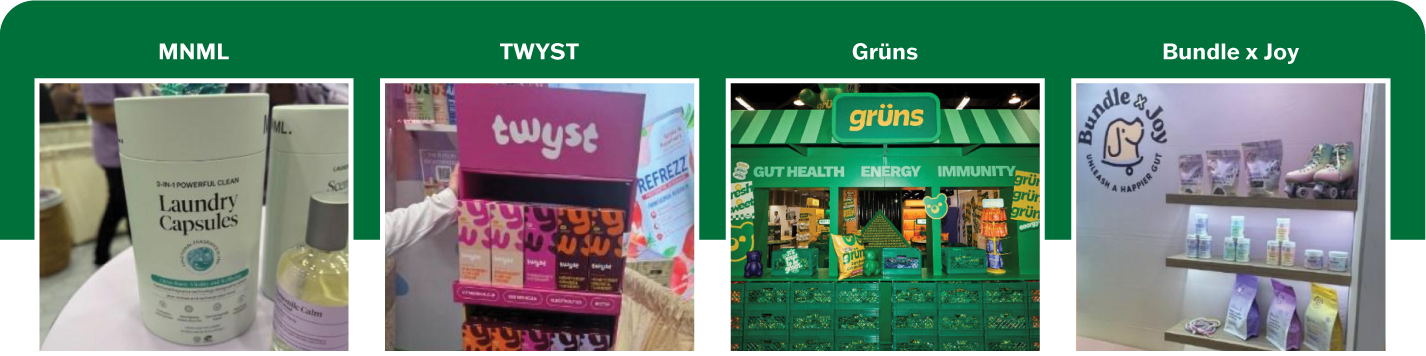
For years, functional health lived mostly in the world of VMS—clinical language, supplement bottles, and benefit-heavy messaging defining how consumers accessed wellness benefits. Over time, beverages helped bring functionality into more everyday routines. But Expo West suggested the next chapter may already be underway: functionality escaping both capsules and drinks to show up in entirely new formats.

Across the show floor, benefits like energy, focus, gut health, glow, and relaxation were showing up in formats designed to spark curiosity and trial—from gummies, laundry capsules, pouches, gums, superfood spreads, skincare, wellness straws, and pet products. As the functional marketplace becomes increasingly crowded, brands are experimenting with formats that make wellness feel less clinical and more playful. Instead of asking consumers to adopt a strict regimen, these products weave functionality into everyday moments—inviting people to experience health benefits in ways that feel more surprising, accessible, and fun.

Date Dynamism

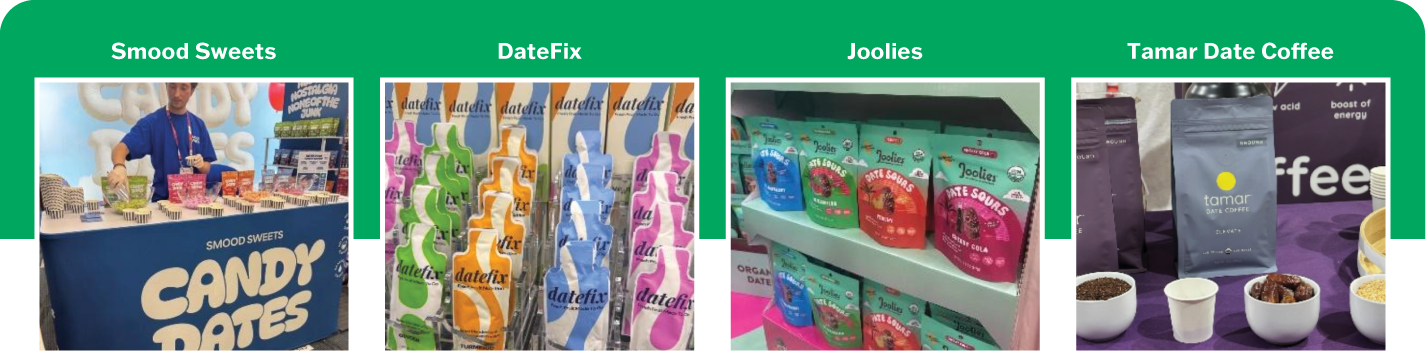
Dates are having a moment—and this year they were everywhere. While we spotted early signals of this trend last year, Expo West 2026 made it clear that dates are moving into the spotlight. Across the show floor, they showed up in formats ranging from snack bars and chocolates to syrups, spreads, and beverages, signaling that the ingredient is quickly expanding beyond its traditional associations. More than just a fruit, dates are increasingly being used as a way to deliver sweetness, texture, and substance across categories.

Their rise is also tied to a broader sweetener identity crisis. As consumers grow more skeptical of refined sugar, artificial sweeteners, and newer alternatives that can feel overly engineered, brands are actively debating what sources of sweetness feel most natural, trustworthy, and nutritionally meaningful. In that conversation, dates stood out as a clear frontrunner. They bring natural sweetness alongside fiber and other nutrients while offering something many sweeteners do not—satiety and a lower glycemic index through the combination of fructose & glucose. In a landscape full of sweetener confusion, dates are emerging as an ingredient that helps products feel both indulgent and wholesome.

Social Sipper Shifts

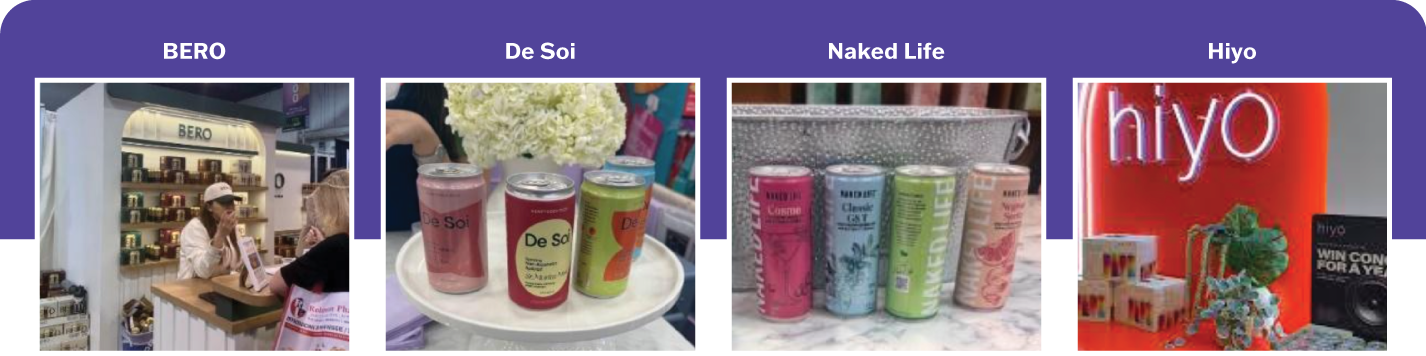
The sober-curious movement isn’t slowing down—but the category built around it is evolving. For years, alcohol-free beverages largely positioned themselves as substitutes for traditional alcohol, often centering on mimicry and replacement. But Expo West suggested the space is starting to move beyond that frame. Across the show floor, beverages were increasingly positioned around the feeling they create—whether that be calm, relaxation, uplift, focus, or a more social kind of buzz.

That shift points to a bigger change in what these drinks are being asked to do. Rather than simply standing in for alcohol, they are helping create entirely new rituals around how people unwind, connect, and socialize. For many younger consumers, alcohol is not necessarily something they are trying to replace—it is simply less central to their lifestyle to begin with. As a result, the opportunity is expanding from alcohol removal to mood creation—with brands designing beverages for the vibe, not just the void.

Metabolism to the Masses

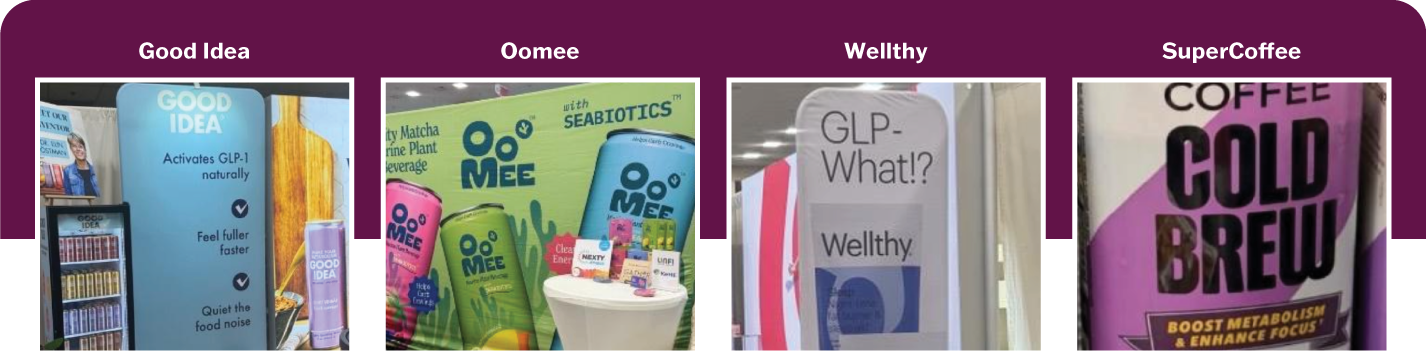
For years, metabolism mostly lived in the worlds of clinical nutrition, fitness culture, and wellness diehards. Not anymore. Thanks in large part to the rise of GLP-1 medications, metabolism has entered the mainstream in a whole new way—bringing concepts like blood sugar balance, satiety, gut health, and metabolic efficiency into everyday consumer conversation. Expo West made it clear that brands are moving quickly to meet that shift, whether by speaking directly to GLP-1 users or by tapping into the broader outcomes people increasingly want: fullness, steadier energy, better blood sugar balance, and more support for weight management.

What stood out most was how quickly metabolism is becoming part of the vernacular. As consumers get more familiar with the mechanisms behind hunger, fullness, and weight, metabolism is starting to feel less like a niche health concept and more like everyday wellness shorthand. People are not just chasing weight loss—they are getting smarter about the system behind it.

Spotlight on Socials

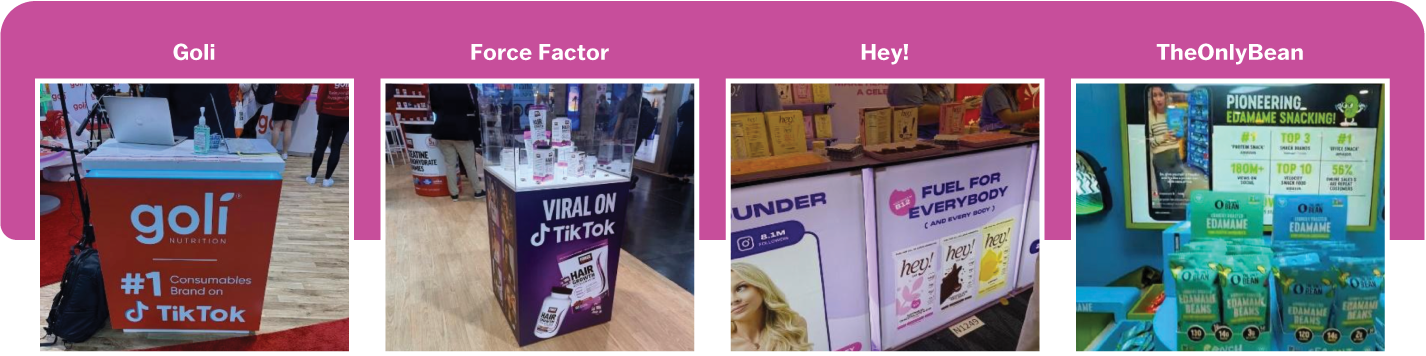
Scroll, like, buy, repeat. Social commerce has officially entered its main character era. Across Expo West, TikTok Shop, creator-led commerce, and social buzz came up again and again as powerful engines of discovery and demand generation. But more than that, social traction increasingly seemed to function as a kind of proof point—evidence that a brand has relevance, resonance, and real consumer pull. Booths proudly called out viral moments, creator momentum, and online success as signals that the brand was already winning with consumers.

That shift showed up across the show floor. Booths were designed to be filmed, shared, and talked about, with interactive activations and visually punchy moments built for content. Celebrity-backed brands added another layer of buzz, using star power to drive awareness and amplify talk value. Altogether, the message was hard to miss: in today’s landscape, success is not just measured by distribution—it is measured by attention. Social credibility is increasingly becoming both a reason to believe in a brand and a leading indicator of who earns the next shelf set.

Natural Foods, Now Functional

For years, Expo West innovation largely meant adding something extra—adaptogens, probiotics, collagen, or another functional boost layered onto foods and beverages. This year, the energy felt different. Instead of only fortifying products from the outside in, brands were increasingly unlocking functionality from the inside out—either by reengineering familiar foods to do more or by spotlighting the benefits already inherent in natural ingredients.

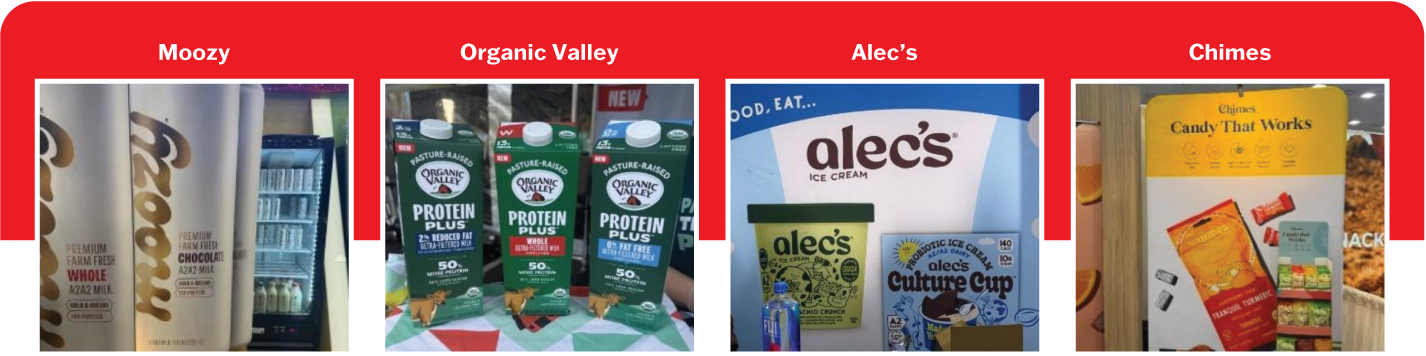
Dairy was one of the clearest examples of the first path. Once limited by a more traditional understanding of what milk could be, the category is being modernized through things like A2 proteins, ultrafiltration, and improved digestibility—expanding milk’s functional potential for today’s consumer. At the same time, other brands were leaning into the naturally occurring benefits of ingredients themselves, highlighting the specific compounds and properties found in foods like tomatoes, tart cherries, and ginger. Together, these approaches point to a broader shift: in a world increasingly skeptical of ultra-processed foods, functionality feels most compelling when it comes from real foods—or from a smarter understanding of what those foods can already do.

Back to Basics in Baking & Beyond

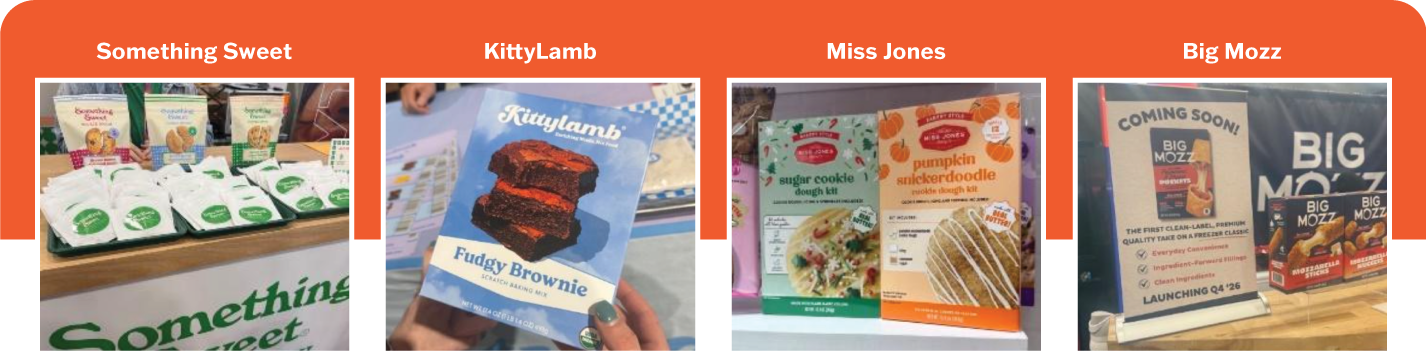
Expo West has long been a playground for reinvention. For years, brands looking to “upgrade” categories often did so by adding functional benefits or reworking familiar foods through alternative ingredients. That innovation was still present this year—but the pendulum also seemed to swing in a different direction: back toward real, simple, delicious food.

That shift showed up most clearly in baking, but it extended into other indulgent categories too. Whether in sweets, pizza, or comfort-food classics, brands seemed less interested in reinventing the original and more interested in restoring what made it lovable to begin with. Across categories, the emphasis was on cleaner ingredient decks, more premium formulations, and foods that felt more homemade, artisanal, and true to the enjoyment of the original. More than anything, these brands seemed focused on closing the gap that has so often existed between “better-for-you” and genuinely delicious—proving that high-quality ingredients and real enjoyment do not have to be at odds.

Frozen Coming for Foodservice

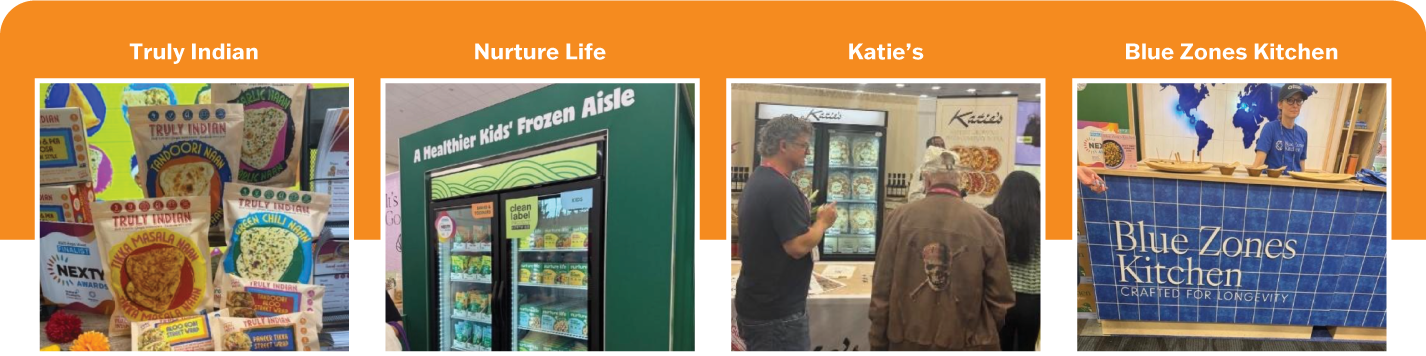
Boy, has the frozen aisle leveled up. A new generation of brands is working to reintroduce consumers to frozen by delivering the kind of quality, culinary credibility, and ingredient integrity that many may not associate with the set. Across Expo West, frozen products showcased globally inspired meals, chef-driven recipes, and cleaner ingredient decks designed to rival the quality and excitement consumers increasingly expect from foodservice.

That shift was especially visible in globally inspired cuisine, where frozen brands brought more authenticity, culinary specificity, and restaurant-like appeal to the aisle. Whether through dumplings, noodles, curries, or grain bowls, frozen brands seemed less interested in acting like pantry staples and more interested in acting like your favorite takeout spot. For consumers who may have written off the freezer years ago, these brands are making a case to come back—offering the convenience of frozen without the compromise once associated with it. As restaurant prices climb and convenience remains non-negotiable, brands that can deliver authentic, foodservice-quality experiences from the freezer are well positioned to win. The result is a growing standoff between restaurants and the frozen aisle—and frozen is coming in hot.

Expo West is where early signals start to look like real momentum. This year’s show made clear that consumers are seeking products that feel more real, more purposeful, more delicious, and in step with how they want to live.

Curious how your business can get in on these and future trends before they gain momentum at Expo West? As always, we welcome conversation at info@seuratgroup.com.

Challenger Brand Study 2026

Challenger Brand Study 2026

Challenger Brand Study 2026

Challengers who modernize and redefine thier categories

Challenger brands are lauded for their disruptive values and their outsized contribution to CPG growth. While many “challenger” brands often play on the fringes, true breakthrough comes from going beyond niche disruption to redefining and modernizing existing categories.

This year’s study focuses on the next wave of challenger brands that are reigniting both consumer relevance and growth within their categories, not just for themselves.

Against a backdrop of stagnating unit growth and rising anti-consumerist sentiment, these brands demonstrate how to drive durable category value creation. They’re infusing new energy and modernity into sleepier categories by leaning into better-for-you ingredients, unlocking new consumption occasions, and leveraging lifestyle-driven branding to deepen consumer connection. In doing so, they’re pulling their categories back into the cultural zeitgeist and bringing new consumers into the fold.

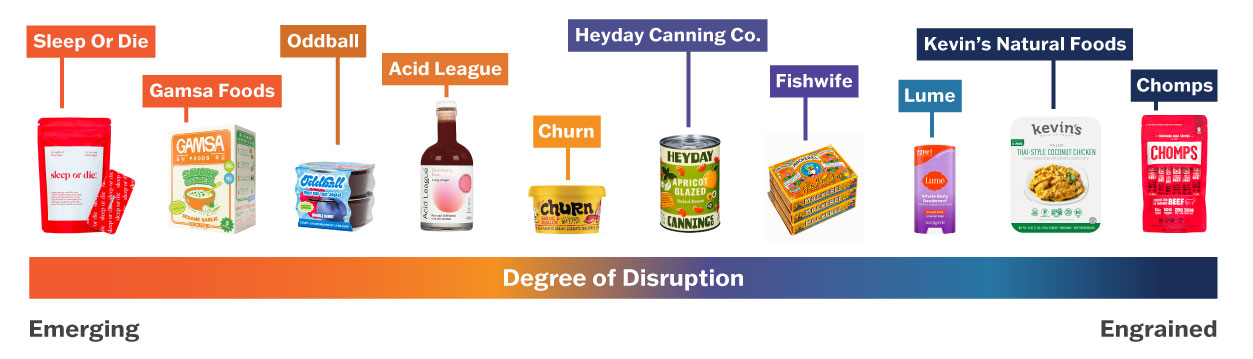
We are excited to highlight 10 challenger brands across a spectrum of disruption: from emerging challengers pushing boundaries to more established modernizers that have already reshaped consumer expectations.

What stands out across these brands is not a single playbook, but a shared orientation in designing for the future of the category, not fenced in by its present.

Challenger Brand Category Impact Spectrum

Sleep or Die: Sleep or Die is jolting the sleep aid category awake with provocative energy and functional credibility in a space that long felt clinical, lifeless, and, well, sleepy. Recognizing that millennials and Gen Z are desperately seeking rest but rejecting the sedative-heavy, side-effect-laden solutions of the past, the brand taps into a cultural shift where younger consumers are embracing wellness rituals but still crave the bold aesthetics of nightlife culture. By pairing credible functional ingredients like melatonin, L-theanine, and GABA with irreverence and design that feels more like a nightlife brand than a pharmacy product, then delivering it in a tab format that feels edgy and unexpected, Sleep or Die transforms the nightly wind-down into something bold and intentional. Sleep or Die is not just refreshing the sleep aid category. It is turning the nightly wind-down into something bold and current, not tired and medicinal. (Source 1 | Source 2 | Source 3

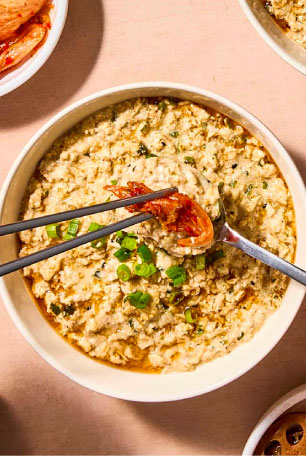
Gamsa Foods: Oatmeal is widely viewed as a healthy breakfast staple, but most bowls rely on sugary add-ons to make them appealing, leaving a gap for tasty, convenient, and savory breakfast options. Gamsa Foods recognized an opportunity to modernize without asking consumers to abandon familiar morning habits, introducing savory oatmeal inspired by traditional Korean porridge. Each bowl blends oats with quinoa and rice, layered with bold, umami-forward flavors like sesame, garlic, miso, and seaweed, delivering the warmth and comfort of a home-cooked Korean breakfast in a format ready in minutes. By infusing oatmeal with global flavor and cultural relevance, Gamsa reopens the breakfast category to savory, culturally grounded eating in a space long dominated by sweetness and sameness. (Source 1 | Source 2)

Oddball: Gelatin snacks have long been defined by a single legacy player, beloved for nostalgia but increasingly misaligned with modern expectations around ingredients and wellness. Oddball identified why consumers were quietly walking away. It was not because they stopped loving the jiggly, playful format, but because it no longer felt worth the compromise. By rebuilding jelly snacks with real fruit, plant-based gelling agents, and cleaner ingredients, Oddball gives consumers permission to enjoy a familiar childhood ritual without the artificial baggage. In a world where indulgence increasingly needs permission, Oddball offers a way to keep the fun without the guilt. With growing retail distribution and seed funding fueling expansion, the brand shows how even the most entrenched nostalgia-driven categories can be meaningfully modernized without losing their sense of joy. (Source 1 | Source 2 | Source 3 | Source 4)  

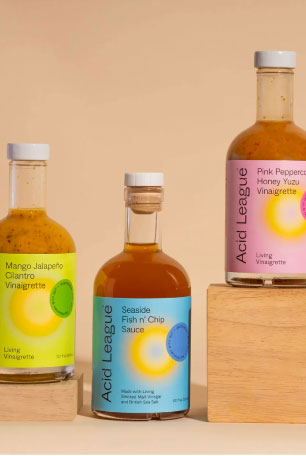
Acid League: The vinegar category has long suffered from low mindshare, treated as a commodity rather than an ingredient worth exploring. Acid League recognized that the category was quietly primed for a renaissance as interest grew in flavor complexity, functional benefits, and more creative uses for everyday pantry staples. By introducing premium, small-batch vinegars with bold, culinary-forward flavor profiles and design that feels curated, the brand repositioned vinegar as something to discover rather than simply stock. It turns vinegar from a dusty bottle in the back of the pantry into a flavor tool people actually want to reach for. As the category expands, Acid League sits squarely within a broader revival of this ancient functional food, unlocking new relevance and new usage occasions along the way. (Source)

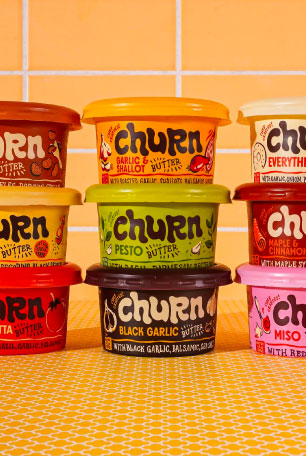
Churn: Founded by Chef Michael Tashman, Churn offers flavor-packed, wholesome butters designed to transform any dish into a bold, satisfying moment. From Parmesan and Pepper to the sweet warmth of Maple and Cinnamon, each tub is built to be a consumer’s sous chef, a simple tool that lets anyone confidently, conveniently, and affordably elevate their cooking. The brand wins by activating at the intersection of three emerging consumer trends: demand for convenience, flavor curiosity, and a preference for wholesome ingredients. In an era of burnout and economic uncertainty, Churn gives people a way to feel creative and capable in the kitchen again without more effort. In doing so, it helps turn a basic commodity into an accessible form of everyday indulgence. (Source)

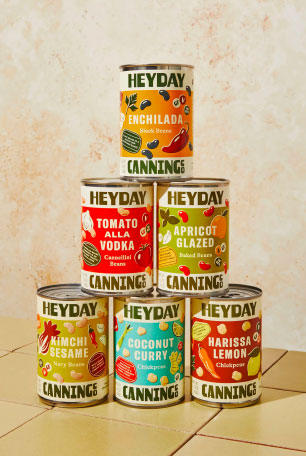
Heyday Canning Co.: Heyday taps into a simple tension: consumers love cans for their practicality, but the food inside has historically been uninspiring. The brand closes that gap by bringing creative flavor combinations and fresh-tasting, high-quality ingredients to a format people already trust. It delivers the cozy, nostalgic comfort of classic canned soups and pantry staples while pairing it with modern recipes and aesthetic packaging that feel genuinely exciting rather than like a compromise. As Heyday gains traction, including its recent launch at Target, it is helping the legacy canned food category evolve its relevance for today’s consumers. In doing so, Heyday is reintroducing an entire generation to canned food as something worth choosing, not just settling for. (Source)

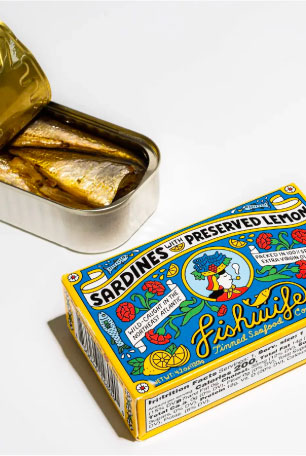
Fishwife: Fishwife is infusing bold flavor and fresh energy into a category that long felt bland and overlooked in the United States. Inspired by the high-flavor tinned fish culture of Spain, the brand taps into growing culinary curiosity and interest in globally inspired foods. By pairing sustainable, ethically sourced seafood with vibrant design and modern flavor profiles, Fishwife transforms tinned fish into an affordable, everyday luxury. The brand leans into charcuterie and “girl dinner” trends, delivering bites that are delicious, nutritious, and picture perfect. Fishwife is not just refreshing tinned fish. It is attracting entirely new consumers and redefining what canned seafood can represent in modern food culture. (Source 1 | Source 2 | Source 3)

Lume: Born from OB-GYN Shannon Klingman’s experience with countless women raising concerns about body odor below the belt, Lume has reshaped expectations in deodorant by leading the charge on whole-body odor care. From traditional sticks and sprays to creams, cleansing washes, and wipes, Lume takes a different approach by acidifying the skin to block odor before it starts, using mandelic acid instead of aluminum or harsher, irritating ingredients. The brand also takes an unapologetic approach to education and destigmatization, openly talking about odor on social media in a way no one else in the category does. In doing so, Lume expands deodorant from a single-use product into a broader personal care category built around whole-body confidence. (Source)

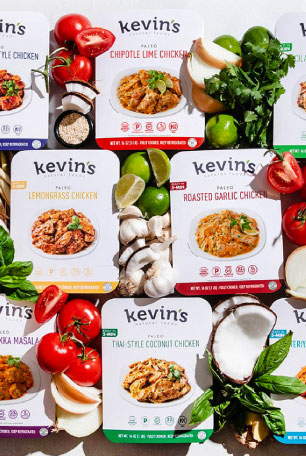
Kevin’s Natual Foods: Kevin’s did not just modernize frozen and refrigerated meals. It permanently changed what consumers and retailers expect from the category. Before Kevin’s, convenience meals were synonymous with compromise: heavy, artificial, and nutritionally suspect. Kevin’s proved that ready-to-heat could be clean, flavorful, and genuinely aspirational. Built on sous-vide preparation and real culinary flavors, the brand unlocked a new consumer truth: busy people no longer accept “good enough” food. Kevin’s explosive, unicorn-level growth forced retailers to re-architect the frozen aisle, making space for premium, chef-driven entrées and catalyzing the “fancy frozen” movement now sweeping the category. The brand’s 2023 acquisition by Mars is not just an exit story. It is evidence that Kevin’s successfully reset the economics and expectations of convenience food, pulling an entire category into a more premium, health-forward future. (Source 1 | Source 2

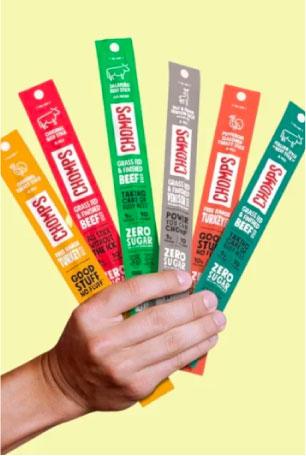
Chomps: Meat snacks carried baggage: perceived as over-processed, nutritionally suspect, and limited to a narrow consumer base. By rebuilding meat sticks with simple ingredients, clear quality credentials (100% grass-fed, Whole30-approved), and elevated packaging, Chomps made meat snacks feel modern, trustworthy, and approachable. The brand even leans into category stigma with self-aware messaging, “all the stick without the ick,” helping disarm skeptics and invite first-time users into the set. Chomps has already shifted the category’s center of gravity. Roughly two-thirds of its consumers were new to meat snacks before discovering the brand, helping establish clean-label protein as the new baseline for what meat snacks should be. Now one of the fastest-growing food brands in the U.S., Chomps is not just benefiting from category momentum. It helped create it. (Source 1 | Source 2)

Implications for All Brands

The challenger brands in this year’s study show how the challenger mindset has evolved. Across categories, these brands are actively reviving familiar categories and redefining what they stand for, and reimagining what they can become.

Even the most established categories can be reignited with the right insight and conviction. Because the strongest challengers do not just grow themselves, they help shape what comes next for the entire shelf.

As always, we would love to hear from you. If you would like more information on any of our challenger brand studies, or want to share a brand of your own, please reach out at info@seuratgroup.com.